Showing posts with label Macquarie University. Show all posts

Thursday, November 11, 2010

Photo competition....

Delighted to have just learned that I've won first prize in the inaugural Macquarie University Arboretum photo competition! And also delighted that the prize is $500 cash. Whoop!

Here is the image: an Angophora I walk past every day from the railway station.


Personally, the judges' choice rather surprises me, because I think that there are others among the finalists far better than this, but I am absolutely not complaining.

As you can see from all the images, the flora on the Macquarie campus is just beautiful. So much open space, wonderful landscaping, and a huge variety. Congratulations to all the other photosnappers, and thanks to the judges!

Friday, September 17, 2010

Department of Biology... Open Day 2010

I thought I'd play with Flickr's slideshow embedding function. Rather cool, I think!

These photos are from Macquarie University's Open Day earlier this month:
  • Jonno and his Eclectus parrots, Eclectus roratus. Interesting sexual dimorphism, probably related to their polygyny: the female is red, and the male green. 
  • Adam Stow with an Olive python: Liasis olivaceus. Adam is a conservation geneticist and my supervisor for my 2010 Advanced Biology Internship.
  • Prospective students exploring geekery in one of our teaching labs.
  • Queuing for fairy floss: Macquarie University Biological Society rots the teeth of prospective students.
  • Pteropus poliocephalus, a grey-headed flying fox (fruit bat).
  • A mantis eats a cricket.
  • A couple more photos of the Olive python, including one with its very close friend Siobhan. 
  • Tawny Frogmouth: Podargus strigoides, doing its stump impersonation.
  • Green tree frog: Litoria caerulea.
  • Blue tongue lizard: Tiliqua scincoides scincoides.
  • MUBS friends Eleanor and Renee with a St Andrew's Cross Spider, Argiope keyserlingii


Friday, August 27, 2010

Adventures in a subtropical rainforest: Part 1

Yesterday I flew home from a six day field trip to Bulburin National Park, in Queensland. It's just a touch south of the Tropic of Capricorn.


View Bulburin National Park, Queensland in a larger map


I was there as part of my role as research assistant to Chris Lusk, of Macquarie University's Department of Biology. Chris runs the Forest Ecology lab. He's researching the relationship between shade tolerance, light and growth in a range of rainforest tree species across tropical, sub-tropical and temperate rainforests in Australia and New Zealand. Later this year, we'll be visiting a temperate rainforest in South-West Tasmania.

Among the measurements we made at Bulburin was the light reaching individual saplings through the canopy. This is done by hemispherical photography, which uses a fish-eye lens and records the light obstruction by surrounding trees and shrubs. Here's an example that Chris took on a previous field trip:


When I get back to the lab, one of my jobs will be to work out the precise amount of light that reaches each of the hundreds of specimens we tagged and measured.

Over the next few posts, I'll be putting up some photos of the rainforest and surrounds. The camera very much enjoyed its workout in the bush!

Next post: The fight for light.

Monday, June 21, 2010

Heck.

I am so happy to let you know that my blog post on the evolution of chloroplasts has come third in the 2010 3 Quarks Daily Prize in Science, judged by Richard Dawkins! I am now the delighted recipient of the Charm Quark. Those of you who are regular readers will know that this is a pretty humble blog in the scheme of things. It's fantastic that 3 Quarks Daily is supporting bloggers like me who don't get huge traffic or coverage out there in the world. It should be an inspiration to everyone who taps away quietly in their garret, wondering if there's anybody out there reading. 

The 3 Quarks Daily people asked me to post my acceptance speech on their site, and this is what I wrote:

I feel utterly charmed!

Thanks so much to the good folk at 3 Quarks Daily, to those who voted for my blog post, and of course to Richard Dawkins. I’ve been a fan of his since I first read “The Selfish Gene” back in the seventies, and knowing that he came to visit my little blog and liked what he read is both boggling and thrilling.
 
They say that you should write about what you care about, and that’s just what I did in posting on the evolution and genetics of chloroplasts. I’ve come late in life to biology, having spent time on a couple of earlier careers. My childhood growing up on the outskirts of Sydney with weekends pottering in the bush instilled in me a love of Australian flora, and that in turn directed me to horticulture. When I studied it, however, I realised quickly that it wasn’t going to teach me the nuts and bolts of how plants work. For that I needed a science degree and so I returned to Macquarie University. After my first lecture in my first biology unit, I knew I was absolutely in the right place. 
I want to express my deep gratitude to the biology staff at Macquarie, who have been unremittingly encouraging of my passion for science and general geekiness. Without their support I’d never have had the courage to try writing about biology. In particular, thanks to Dr Adam Stow (the Genetics lecturer for whom I prepared the presentation on which the blog post is based, and who is now supervising my internship in his lab), to Associate Professor Brian Atwell (my planty mentor) and to the Head of the Department of Biological Sciences, Professor Lesley Hughes, who always seems to have time for me. And finally, my fellow student and dear friend, Julian May: thanks for the nomination! 
Congratulations to the other finalists and winners. The standard of their work is magnificent, and I feel very proud to be in their company.
And thanks of course to my husband, Martien and my daughter, Maxine. No one could ask for a family more tolerant and supportive of a somewhat obsessive and passionate biogeek. 

Thursday, June 17, 2010

A change in season.

Exams are nearly over for the semester, and once they're finished I'll find myself in the curious position of being free of them for some time. I'm taking a sabbatical, if that is something an undergraduate is entitled to call her break from the routine of exams and assignments and lectures and pracs. Next semester, I'm only taking one unit in my degree: the final half year of 3rd Year Advanced Biology. That's primarily going to entail an internship (starting on Monday) in the Conservation Genetics Lab with Dr Adam Stow and Ph.D student (and wildlife photographer!) Paul Duckett. I'm assisting with genetic analyses of a species of tree skink. It's a great opportunity to learn more about a field that fascinates me and essential techniques of the trade. My goal is one day to use this knowledge and somehow apply it to plants and their symbionts. Not entirely sure how, yet....

I've also just been appointed to an exciting new job as a part-time research assistant with Dr Chris Lusk, starting late July. Chris is researching juvenile rainforest plants, and later this year we're off to some fabulous locations to do field work, including western Tasmania. That part of the world boasts some of the most ancient and pristine rainforests on the planet. I touched the edge of them a few years ago, on a family holiday to Tassie. It's almost impossible to express just how beautiful Tasmanian wilderness is. So I'll content myself with some photos of that trip.

 The Gordon River, Western Tasmania

Huon Pine rainforest. 

To return to this place with a botanist's eye is a thrilling prospect.

But almost as alluring as all this is the chance of spending more time in the garden. The Forest of Sabine is growing apace, and I'm starting to think about filling in the gaps between the trees and shrubs--and things for planting in any other spots I can find. I've been amassing seeds and once the weather warms up I'll be germinating them in the shade-house.

The seeds so far:
  • Lomandra filiformis, a graceful monocot with thin, strappy leaves with a beautiful bluey-green tinge.
  • Poa labillardierei, Common Tussock Grass.
  • Dianella caerulea, Paroo Lily or Blue Flax-lily. It's a useful clumping monocot with small but spectacular blue and yellow flowers.
  • Anigozanthus flavidus, Kangaroo Paw. This is a bit of a cheat. It's not local, but comes from Western Australia. And it needs lots of sun, so won't work in among all the other plants. But I love it, and who wouldn't? Fabulous flowers, unlike anything else you'll find.
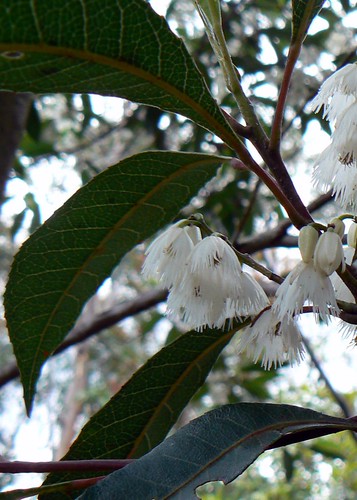
  • Elaeocarpus reticulatus, Blueberry Ash. A small tree with delicate white or pink flowers. We already have one (white flowered, as you can see), but who could resist more?
Elaeocarpus reticulatus.
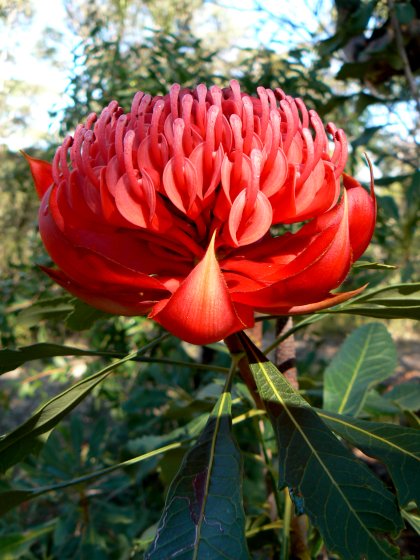
  • Telopea speciossima, Waratah. We don't actually need any more of these because the Forest of Sabine is brimming with them, but I thought if I could grow a few they'd make nice presents for plant-loving friends. Here's a shot we took of one in nearby bushland.
Telopea speciossima
Finally, I'm going to spend more time blogging about plants and science. Those nice folk at 3 Quarks Daily have inspired me!

Wednesday, November 05, 2008

Paul Ehrlich

Today was the inaugural Macquarie University Annual Evolution Lecture, given by Professor Paul Ehrlich, based on his latest book (co-authored by Anne Ehrlich), The Dominant Animal: Human Evolution and the Environment. It's an excellent innovation by the university, deliberately instigated to raise awareness of evolutionary theory and combat the force of darkness that is "intelligent design".

His excellent lecture--sobering yet entertaining--was recorded, so if a link becomes available I'll post it here.

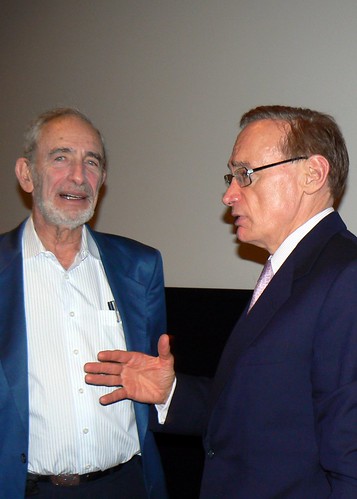
He was introduced by former NSW Premier, Bob Carr.

Paul Ehrlich and Bob Carr
Paul Ehrlich (left) with Bob Carr.


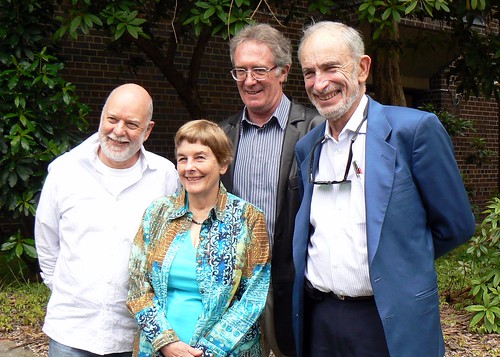
Biologists
From left to right: Professor Andy Beattie, Dr Anne Ehrlich,
Professor Dave Briscoe and Professor Ehrlich.

Andy Beattie is a professor in biology at Macquarie University, and director of the Commonwealth Key Centre for Biodiversity and Bioresources, and co-author with Paul Ehrlich of Wild Solutions: How Biodiversity Is Money in the Bank.

Dave Briscoe is Head of the Biology Department at Macquarie. He was my first biology lecturer in my BSc, and has been amazingly supportive and encouraging of my studies. Unfortunately, Dave is retiring this year. He's a natural and inspiring teacher--so sad to see him leave.

And heck, Obama is going to be US President. Here's hoping the change we've been hearing about really happens. The world needs it, desperately.

Sunday, October 26, 2008

Changes....

At the end of November, my contract with Australia's Virtual Herbarium at the National Herbarium of NSW expires as a result of that great constant in the world of science: funding running out. So I've been quietly hunting for new work, and verily, it has come to pass! Next year I'll be starting a job at Macquarie University as a part-time research assistant for six months or so, working with Associate Professor Brian Atwell of the Biology Department, who is doing research into Australian native rice (Oryza species).

It fits brilliantly with my plans: I'll be able to work in between lectures and pracs; it'll mean no more commuting to the city; it's hands-on work; it's potentially important research in terms of high protein crop development in a world of hungry people and changing climate; and best of all, I'll be doing Real Science!

But first, I have to finish this semester.... Exams loom. So excuse me if I continue to be a bit remiss in looking after this blog. See you when I come up for air again.

Friday, June 15, 2007

Uni Daze

This week, I visited Macquarie University to put in the application for the first course in my BSc in Conservation and Biodiversity.

Culture shock, frankly.

It occurred to me that it's now *cough* thirty years since I started my first degrees (Arts/Law). Thirty years?! Okay, so I've had a very full and satisfying life in those years--marriage(s), a baby now a big girl, a career in screenwriting and stage and a minute or so in law, travelling around the world a few times, plant stuff--but still, it's a bit spooky.

The place has changed a lot. Everything, of course, is digitalised now. The uni even has an on-campus wireless service (note to self: buy laptop). PCs didn't even exist when I started uni. I thought I was so hi-tech because I wrote my essays on an electric typewriter with a daisy wheel and a very exciting innovation--the eraser ribbon.

The old union cafetaria now resembles a Westfield foodhall. (It's not allowed to be called a "union" any longer in these politically correct Howard days. "Union" is a dirty word. Any minute now it'll be expunged from the Anglican marriage service.) There's not much sign of politics there nowadays. In the seventies, the walls were covered in political posters, but now, there are lots of ads for various Christian groups. Ugh.

The old Jughouse Theatre where I spent a huge chunk of my youth has been replaced by a motorway, and the on-campus house I shared with various mates in Culloden Road is no more. The uni now sprawls with dozens of new buildings, but the architecture and landscaping look great. I'd have loved a lake like this when I was there first time round....


This photo is from Macquarie's website, taken by Damian Moran. Browse the pics. They're really lovely.

Looking through the staff directory, I can find none of my old lecturers and tutors. I guess they're all retired or dead! But an old mate, Andrew Simpson is there. We were undergraduates together, and now he's Dr Simpson, Director, Museum Studies Program, Division of Environmental and Life Sciences. It'll be good to catch up with him for some ancient gossip.

Another deluge of rain this weekend, this time, landing on the catchment for Warragamba Dam. The dam stats are going to look better than they've been for ages. Unfortunately, the rain is heavy in the Central Coast region which is still flooding from last weekend.

I keep looking anxiously at the trees in our garden, but they're hanging on. There's a waterfall behind our neighbour's house, and I took this photo this morning.

Buckets of the wet stuff!


While I was down there, I spotted this sign....


It'll be wonderful seeing brush turkeys (Alectura lathami) active during the breeding season. I wonder if my new plants will survive.


At some point, I hope I'll be able to take a photo to show you, but in the meantime, here's an image from the Canberra Ornithologists Group.


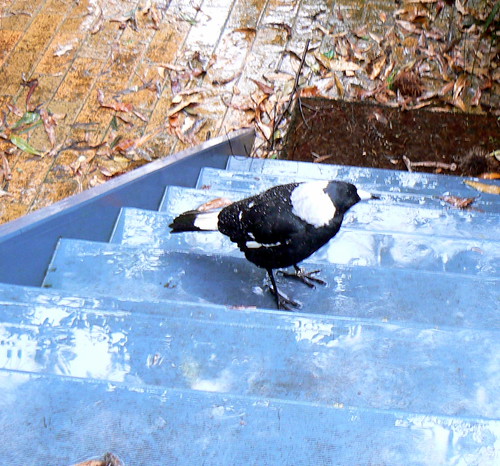
And here's Mungo, a magpie (Gymnorhina tibicen) that has adopted us. It seems he might have been hand raised, because he's ridiculously tame. His flight feathers are cut, so someone is obviously "keeping" him. After the last storm, he vanished for a few days but now he's back.


But I do wish he'd get out of the rain.

Sunday, February 04, 2007

Flicking flowers, Fire and the Future

Sorry. That level of alliteration really is quite unforgivable.

The first F relates to my photo of a Stylidium productum flower I posted here previously. It's just been published on Botany Photo of the Day, here. Thanks, Daniel! If you're into plants and you haven't yet subscribed to BPoD, then you should. Most of the photos there put mine to shame, but I'm pretty happy with those Daniel's published: Dendobium speciosum and Telopea speciosissima 'Wirrimbirra White'.

The slogan of Botany Photo of the Day is "In Science, beauty. In beauty, science. Daily." I love that. It distills what Dawkins talks about in Unweaving the Rainbow.

F #2 is fire. As I was travelling up to the Central Coast on a Herbarium internship field trip, we passed the bushfires that were besetting Mount Kuring-gai, less than a kilometre from our new home. This is a photo taken on 22 January, looking towards Sydney from Staples Lookout on the Kariong-Woy Woy Road, showing the smoke from the fire.


Such an ominous sight, and I hated being away from my family while we all worried.

We visited Mount Kuring-gai yesterday, to see the damage. While from the ridge you can see a lot of blackened damage from spot fires, the areas around the houses have only been browned by back-burning by the Rural Fire Service. It's distressing to know that the fire was caused either by an arsonist or by an idiot careless with a cigarette butt, but fortunately the fire near us wasn't too intense or extensive. Already there are signs of regeneration: lomandra appearing from the earth, xanthorrhoea leaves exploding from charred stumps. By the time we move in, there will be a lot of action. By the time the fire was controlled, a total of over 1,000 hectares were burnt. Hopefully most of the animals got out of the way....

But I'm afraid I'm not able to post any more photos from my Herbarium exploits yet. So many photos, so much to write, so little time! I'll catch up as soon as I can.

And the final F is my future. My experiences at the Herbarium have thoroughly crystallised my plans for the rest of my working life. A while ago I realised that horticulture wasn't going to be enough for me. Much as I love the practical stuff, I was craving more knowledge and science than my courses were designed to provide. Now I know where I want to go, and it's into botany and biodiversity.

So in the second half of this year, I'm going to go back to Macquarie University, my alma mater, and start studying for a B.Sc in Biodiversity and Conservation. I'll be studying part-time, so am going to look for part-time work in hort/plant science to pay for it. (It's a shock to the system for a girl who did her Arts/Law degrees during the halcyon post-Whitlam era, when tertiary education was entirely publicly-funded. Now, it's expensive. Yikes.)

Catch up soon!

Cheers,

Margaret