At the end of November, my contract with Australia's Virtual Herbarium at the National Herbarium of NSW expires as a result of that great constant in the world of science: funding running out. So I've been quietly hunting for new work, and verily, it has come to pass! Next year I'll be starting a job at Macquarie University as a part-time research assistant for six months or so, working with Associate Professor Brian Atwell of the Biology Department, who is doing research into Australian native rice (Oryza species).
It fits brilliantly with my plans: I'll be able to work in between lectures and pracs; it'll mean no more commuting to the city; it's hands-on work; it's potentially important research in terms of high protein crop development in a world of hungry people and changing climate; and best of all, I'll be doing Real Science!
But first, I have to finish this semester.... Exams loom. So excuse me if I continue to be a bit remiss in looking after this blog. See you when I come up for air again.
Showing posts with label Herbarium. Show all posts
Showing posts with label Herbarium. Show all posts
Sunday, October 26, 2008


Saturday, December 22, 2007
Pearl Beach Field Trip Recce
Yesterday, Louisa and Peta--a couple of my Herbarium colleagues--and I went to Pearl Beach on the NSW Central Coast to check out the place we're staying during the upcoming Plant Science Internship field trip in January. Since I'm going to be cook, I needed to know how well equipped the kitchen is. It's got a big old stove that should happily serve our needs. I just hope my culinary skills do too!
Pearl Beach is a beautiful spot, given to being a holiday house mecca for wealthy celebs, but more interesting for us as an ecologically diverse site for botanising. It's close to coastal heaths, mangrove swamps and temperate rainforest. (Also to leeches, ticks, mosquitoes, sandflies and snakes.... Oh my.)
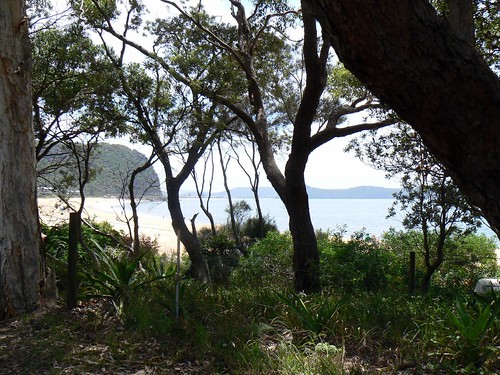
The tree on the left is Melaleuca quinquenervia, Paperbark Teatree, and below, its bark....

This species is typical of the area, growing in coastal swamps and on lake margins on the East Coast of Australia north from Sydney. It's unfortunately become a serious weed in wetlands outside Australia, including in the Florida Everglades, where it grows into huge forests across hundreds of thousands of acres, forming impenetrable monocultures. With the classic irony of the way we screw things up, in some parts of Australia it's becoming quite vulnerable.
Traditionally, Indigenous Australians used the trees for a range of purposes:
And here's a joke, told to me by a plant scientist who is not a molecular biologist:
A molecular biologist was driving through the bush, and came across a farmer herding his sheep along the road. He stopped to let them pass, and got into conversation with the farmer.
"Nice mob of sheep you've got there."
"Yeah. They're good eating."
"Tell you what," said the molecular biologist, "If I can tell you how many sheep you've got, you give me one."
"Okay," said the farmer. "I'm always up for a wager. Go ahead."
"Eighty-six".
"That's pretty good, mate, how'd you work that out?" asked the farmer.
"Oh, in my line of work, you need to be able to quantify things pretty quickly," said the molecular biologist.
"Fair enough," said the farmer. "Help yourself." And the molecular biologist did.
"How about another bet?" said the farmer. "If I guess what your line of work is, you give it back to me."
"All right," said the molecular biologist.
"You're a molecular biologist."
"How'd you know that?" asked the molecular biologist.
"Put down my dog and I'll tell you."
Pearl Beach is a beautiful spot, given to being a holiday house mecca for wealthy celebs, but more interesting for us as an ecologically diverse site for botanising. It's close to coastal heaths, mangrove swamps and temperate rainforest. (Also to leeches, ticks, mosquitoes, sandflies and snakes.... Oh my.)
The tree on the left is Melaleuca quinquenervia, Paperbark Teatree, and below, its bark....
This species is typical of the area, growing in coastal swamps and on lake margins on the East Coast of Australia north from Sydney. It's unfortunately become a serious weed in wetlands outside Australia, including in the Florida Everglades, where it grows into huge forests across hundreds of thousands of acres, forming impenetrable monocultures. With the classic irony of the way we screw things up, in some parts of Australia it's becoming quite vulnerable.
Traditionally, Indigenous Australians used the trees for a range of purposes:
- The bark peels off in strips and has many uses ranging from wrapping food for cooking to making bandages and disposable raincoats. The bark can be used to make containers for food and water storage and for mending holes in canoes.
- A liquid made from the leaves can be used as a wash. The leaves can also be boiled to make a pleasant tea.
- The nectar-rich blossoms can be soaked in water to make a sweet drink.
- All species of melaleuca can be used to treat symptoms of colds, flu and sinusitis by inhaling the steam from boiling or burning the leaves. The young leaves can also be crushed in the hands and released oils inhaled deeply to relive headaches, blocked sinuses, coughs and runny noses. Source: Botanic Gardens, Sydney.
And here's a joke, told to me by a plant scientist who is not a molecular biologist:
A molecular biologist was driving through the bush, and came across a farmer herding his sheep along the road. He stopped to let them pass, and got into conversation with the farmer.
"Nice mob of sheep you've got there."
"Yeah. They're good eating."
"Tell you what," said the molecular biologist, "If I can tell you how many sheep you've got, you give me one."
"Okay," said the farmer. "I'm always up for a wager. Go ahead."
"Eighty-six".
"That's pretty good, mate, how'd you work that out?" asked the farmer.
"Oh, in my line of work, you need to be able to quantify things pretty quickly," said the molecular biologist.
"Fair enough," said the farmer. "Help yourself." And the molecular biologist did.
"How about another bet?" said the farmer. "If I guess what your line of work is, you give it back to me."
"All right," said the molecular biologist.
"You're a molecular biologist."
"How'd you know that?" asked the molecular biologist.
"Put down my dog and I'll tell you."
Wednesday, December 19, 2007
Flannel Flower Gloat Moment
The photo I posted here a while back of the flannel flower (Actinotus helianthi) I'm growing has been chosen for today's Botany Photo of the Day published by UBC Botanical Garden and Centre for Plant Research.
Which is nice.
Just as jolly is that I've sold my first photo. The Herbarium had an art exhibition over recent weeks, "Our Hidden Talents", to which the staff were encouraged to contribute. I entered four photos, and someone liked this one enough to part with ready cash for it. Heck.
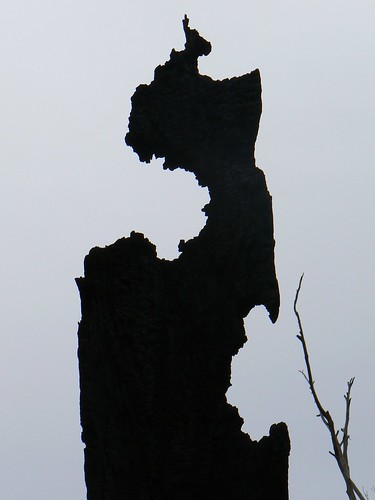
I took this photo, "After the Fire", in February this year, while on the NSW Herbarium Plant Science Internship's field trip to the NSW Central Coast. It's a burnt-out tree in Awaba State Forest.
Which is nice.
Just as jolly is that I've sold my first photo. The Herbarium had an art exhibition over recent weeks, "Our Hidden Talents", to which the staff were encouraged to contribute. I entered four photos, and someone liked this one enough to part with ready cash for it. Heck.
I took this photo, "After the Fire", in February this year, while on the NSW Herbarium Plant Science Internship's field trip to the NSW Central Coast. It's a burnt-out tree in Awaba State Forest.
Wednesday, November 07, 2007
Cryptostylis subulata
Native terrestrial orchids are fabulous little creatures, in part because when they're not flowering, they look very insignificant, and then, suddenly, out burst some of the more macabre inflorescences you're likely to encounter.
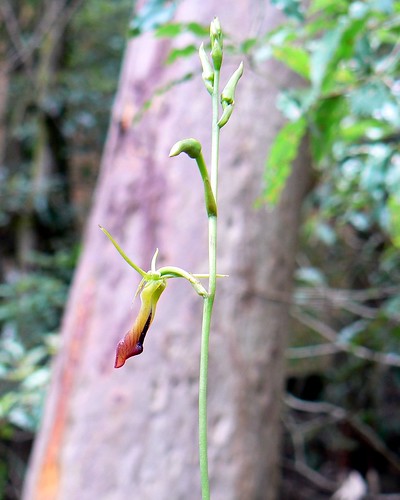
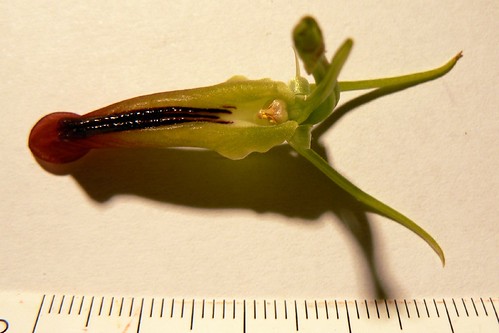
This is a Cryptostylis subulata (Large Tongue Orchid) growing on the sandstone rock platform next to our house. This afternoon, I looked at it under the microscope. Extraordinary textures, but alas my photography can only begin to convey that.
 (Ruler in millimetres.)
I'm planning on preserving a specimen to add to the Herbarium's collection. Unfortunately, it won't dry too prettily, but perhaps they'll be able to use one of my photos on PlantNET.
This is a Cryptostylis subulata (Large Tongue Orchid) growing on the sandstone rock platform next to our house. This afternoon, I looked at it under the microscope. Extraordinary textures, but alas my photography can only begin to convey that.
A close up of the underside of the flower.
(Ruler in millimetres.)Tuesday, October 30, 2007
2008 Plant Science Internship, National Herbarium of NSW--Applications open!
The next Internship (Jan-Feb 2008) is now calling for applications. Anyone who's read my blog and website accounts of this will know how much I absolutely adored it. I am not exaggerating when I say it changed my life. It certainly led to my current job and to my committing to a B.Sc in Conservation and Biodiversity.
If you or anyone you know can spare 7 weeks in Jan-Feb next year to get advanced work experience and training in botanical science, here it is! (Oh, and that's me, third photo down, pretending to mount a specimen. So to speak.)
I'm going on the Internship's Central Coast field trip. My boss said to me, "We can't take you as a scientist, because you're not one yet, but would you like to be the cook?" So I'll be there, wearing the wacky, zany novelty BBQ apron, and hopefully doing a little botanising on the side.
Seriously, this is the greatest thing for someone with a passion for Australian plants, ecology and biodiversity. Pass it on!
If you or anyone you know can spare 7 weeks in Jan-Feb next year to get advanced work experience and training in botanical science, here it is! (Oh, and that's me, third photo down, pretending to mount a specimen. So to speak.)
I'm going on the Internship's Central Coast field trip. My boss said to me, "We can't take you as a scientist, because you're not one yet, but would you like to be the cook?" So I'll be there, wearing the wacky, zany novelty BBQ apron, and hopefully doing a little botanising on the side.
Seriously, this is the greatest thing for someone with a passion for Australian plants, ecology and biodiversity. Pass it on!
Thursday, November 23, 2006
Plant Science Internship
I am absolutely over the moon. I've been accepted into the Plant Science Internship Program at the National Herbarium at the Sydney Botanic Gardens!
The internship takes place over January and February next year, full time. (This means that I'll have to miss my first month of my TAFE studies, but I think I'll be able to manage that okay with the support of my hort friends.)
From the Program's website:
I fully intend to write here about my experiences at the Herbarium. And take lots of photos with the trusty camera.
Callooh! Callay! O frabjous day!
The internship takes place over January and February next year, full time. (This means that I'll have to miss my first month of my TAFE studies, but I think I'll be able to manage that okay with the support of my hort friends.)
From the Program's website:
This program offers undergraduates and recent graduates in the plant sciences advanced working experience in a leading scientific institution. The work program is supported by task-specific training and a professional-level introduction to key areas in Australian plant science and conservation. Specific training is given in skills for job-seeking and higher study....In other words, bliss on a stick.
The program is for students at the end of second or third year, and recent graduates, in botany, ecology, forestry, general biology (with plant interests), scientific horticulture, and related subjects. The program will benefit those seeking professional or technical careers in plant sciences or conservation management....
Interns work full-time on a voluntary, unpaid basis, assisting scientific staff on work of real scientific value. In return, Interns receive extensive practical training in botany, plant conservation, collections management, and job-seeking in the scientific workforce....
Training sessions are led by professional scientists and technicians from the Botanic Gardens Trust and other institutions. Training complements and extends that given at university....
- Work sessions
- Interns work in teams under staff supervision on routine and advanced tasks of specimen preparation, plant identification, collections management, and some research assistance.
- We attempt to accommodate interns’ interests, but allocation to work teams and tasks is at our discretion. The scientific context of all work is made clear – you will be making a real contribution to the running of the Herbarium and its programs, and the skills you acquire will be applicable in many other jobs, especially in science and conservation....
- Training About 40% of time is spent in training sessions. Again, these will be relevant to a wide range of science jobs. You will become familiar with:
- key sources of information on the Australian flora
- plant identification resources
- key sources of information in conservation science and policy
- principles and practice of the curation of scientific collections
- Seminar sessions will focus on theoretical and practical issues in botany and conservation, including current major research programs.
- Field training will include specimen selection and collection, field data recording, and permit and access protocols.
I fully intend to write here about my experiences at the Herbarium. And take lots of photos with the trusty camera.
Callooh! Callay! O frabjous day!
Subscribe to:
Posts (Atom)