Showing posts with label Forest of Sabine. Show all posts

Thursday, June 17, 2010

A change in season.

Exams are nearly over for the semester, and once they're finished I'll find myself in the curious position of being free of them for some time. I'm taking a sabbatical, if that is something an undergraduate is entitled to call her break from the routine of exams and assignments and lectures and pracs. Next semester, I'm only taking one unit in my degree: the final half year of 3rd Year Advanced Biology. That's primarily going to entail an internship (starting on Monday) in the Conservation Genetics Lab with Dr Adam Stow and Ph.D student (and wildlife photographer!) Paul Duckett. I'm assisting with genetic analyses of a species of tree skink. It's a great opportunity to learn more about a field that fascinates me and essential techniques of the trade. My goal is one day to use this knowledge and somehow apply it to plants and their symbionts. Not entirely sure how, yet....

I've also just been appointed to an exciting new job as a part-time research assistant with Dr Chris Lusk, starting late July. Chris is researching juvenile rainforest plants, and later this year we're off to some fabulous locations to do field work, including western Tasmania. That part of the world boasts some of the most ancient and pristine rainforests on the planet. I touched the edge of them a few years ago, on a family holiday to Tassie. It's almost impossible to express just how beautiful Tasmanian wilderness is. So I'll content myself with some photos of that trip.

 The Gordon River, Western Tasmania

Huon Pine rainforest. 

To return to this place with a botanist's eye is a thrilling prospect.

But almost as alluring as all this is the chance of spending more time in the garden. The Forest of Sabine is growing apace, and I'm starting to think about filling in the gaps between the trees and shrubs--and things for planting in any other spots I can find. I've been amassing seeds and once the weather warms up I'll be germinating them in the shade-house.

The seeds so far:
  • Lomandra filiformis, a graceful monocot with thin, strappy leaves with a beautiful bluey-green tinge.
  • Poa labillardierei, Common Tussock Grass.
  • Dianella caerulea, Paroo Lily or Blue Flax-lily. It's a useful clumping monocot with small but spectacular blue and yellow flowers.
  • Anigozanthus flavidus, Kangaroo Paw. This is a bit of a cheat. It's not local, but comes from Western Australia. And it needs lots of sun, so won't work in among all the other plants. But I love it, and who wouldn't? Fabulous flowers, unlike anything else you'll find.
  • Elaeocarpus reticulatus, Blueberry Ash. A small tree with delicate white or pink flowers. We already have one (white flowered, as you can see), but who could resist more?
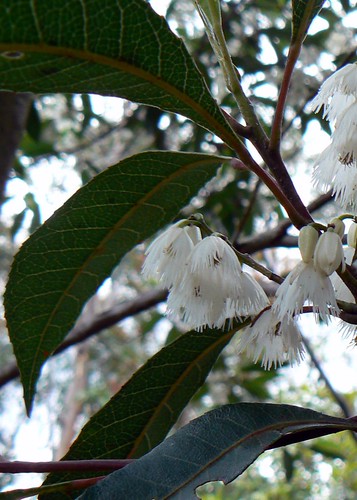
Elaeocarpus reticulatus.
  • Telopea speciossima, Waratah. We don't actually need any more of these because the Forest of Sabine is brimming with them, but I thought if I could grow a few they'd make nice presents for plant-loving friends. Here's a shot we took of one in nearby bushland.
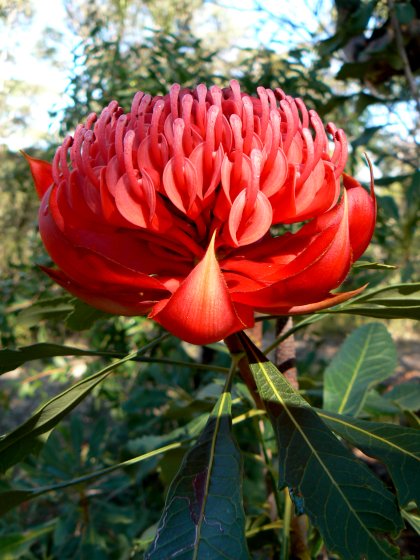
Telopea speciossima
Finally, I'm going to spend more time blogging about plants and science. Those nice folk at 3 Quarks Daily have inspired me!

Saturday, May 15, 2010

The Forest of Sabine: the first flowers

The Forest of Sabine is growing apace. There have been a few casualties, alas, among the Angophora hispida. Sabine tells me that she's had this problem elsewhere: they don't take kindly to transplantation.

Still, there is much new growth among all the other species, in particular with the Acacia parvipinnula. Tender new shoots, and in the last couple of days, flowers!


To give you a sense of size, the mature flowers above are around 0.5cm in diameter.

Saturday, May 01, 2010

The Forest of Sabine: a perfect symbiosis!

I have a confession to make. Over the last year or so, the demands of study and work plus my allergies to ticks, leeches and many pollens have kept me from giving the attention to our garden that it needs and deserves. My negligence has been compounded by a higher-than-normal rainfall over summer.

The result?

Bracken.

Vast tracts of bracken.

From verandah.

That disc-shaped object in the foreground of our front garden is a drowning bird bath. Many of the plants I've put in have struggled to get enough light to survive.

Bad, naughty, wicked Margaret.

But a month or so ago, I was in a queue for coffee at Macquarie, and noticed a woman standing near me whom I recognised by sight.... Perhaps a biology post-grad? So we started chatting, and I asked her how her research was going. Good, she said, but she was having a problem. She needed a site in Sydney to grow some plants for her PhD experiment and was having trouble finding one. What sort of site did she need, I asked. Oh, something near bushland, sandstone substrate, sandy low-nutrient soil. Hmm, I mused. How much land? Enough to plant around eighty plants, ranging from trees to shrubs, all Sydney natives.

And thus began the perfect symbiosis. The PhD student is Sabine Nooten, and here she is:


Sabine is doing her doctorate with Professor Lesley Hughes (the Head of the Department of Biological Sciences), in the Plant-Insect Interactions and Climate Change Ecology Lab (PICCEL). You can read about her research here. As part of her work, Sabine is attempting to predict aspects of insect herbivory in the future: how plants and insects will interact as a result of climate change when Sydney's climate gets as hot as it is currently near the NSW/Qld border. She's been growing huge numbers of specimens at Macquarie University's Plant Growth Facilities (where I've studied and worked over the last year or so) for her various sites, and in the last few week or so, she and sundry colleagues/friends have been planting many of them in our front garden. This will be her control for the experiment. First, of course, she had to ensure that the soil was right. Not too many nutrients, to make it representative of the natural soils of Australia. Unsurprisingly, it passed the test. 

(Side note: Australia's soils are really, really old. The last Glacial Maximum (ice age) ended around 10,000 years ago. Glaciers scraped the surface off the bedrock of Europe and North America, so all the soil that has been deposited there subsequently is really a bit of a baby. Australia, by contrast, has had a relatively stable geology for many millions of years. We don't have much topsoil, and what we do have has been subject to massive erosion and has been leached of nutrients. Our flora has evolved to deal with this, which is why, for example, Australian plants are intolerant of what in Europe and North America would be normal levels of phosphorus. Hence "native plant fertiliser"--low on the stuff that hurts our plants.)

Sabine and her mates have cleared the bracken and planted a number of species, most of which are indigenous to our general area of Sydney:
  • Angophora hispida (Myrtaceae), Dwarf apple or Banda in Cadigal (an Aboriginal language of Sydney). A mallee or small tree to 7 metres high.


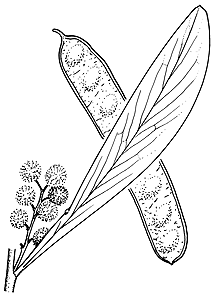
  • Acacia obtusata (Fabaceae), Blunt-leaved Wattle. 0.5-3 metres high. (Couldn't find a decent photo of this online. Once Sabine's flower, I'll take a pic!)
  • Hakea gibbosa (Proteaceae), Needlebush. Shrub, 1-3 metres high. 

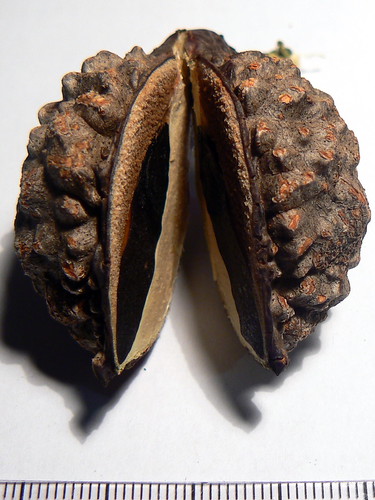
This species is in the same genus as a plant I recently propagated from seed, and am now growing in the garden, Hakea sericea. Both have similar large, tough seed-pods and seriously sharp, hard leaves.

Hakea sericea fruit
mm
Telopea speciossima

And this is what the front garden looks like now:

From verandah
From verandah.

From driveway
From driveway.

Sabine is delighted to have a place to grow her plants where they're protected from vandals/wandering drunks/morons who don't quite understand how precious a PhD experiment is, and where they'll be watered and generally loved. (The fencing is to keep out the dreaded Swamp Wallabies.)

But she can't possibly be as thrilled as I am. All these plants! The bracken gone! What will essentially become a forest in our front yard!

Once the experiment is finished (in around 18 months), I'm going to put in some local understorey plants. But I'm quietly hopeful that they'll emerge naturally. The soil is full of seeds of local plants, just waiting for the right conditions to germinate and grow. Finally, I think they might just get their chance.

So how win/win is all that?!

I'll update the process, once the plants start to take off. Watch this space, come spring.