Showing posts with label Menura novaehollandiae. Show all posts

Sunday, October 09, 2011

Superb Lyrebird mimicry: recording!

I've previously posted about the Superb Lyrebirds (Menura novaehollandiae) in our garden, with the promise that one day I'd upload audio. Today is that day!

Since we've been living here, the lyrebirds have become increasing common and less fearful. Their increased abundance is probably due in part to cat and fox baiting in Ku-ring-gai Chase National Park which anecdotally has increased populations of a range of other native fauna, including the Short-beaked Echidna (Tachyglossus aculeatus), the endangered Southern Brown Bandicoot (Isoodon obesulus obesulus) and the Australian Brush-turkey (Alectura lathami), all of which visit our place. I suspect that the lyrebirds are particularly attracted to our garden because I do a lot of mulching, grow only native plants, and avoid the use of pesticides, so there are plenty of leaf litter invertebrates for them to feast on.

Foreground: a juvenile male.
Background: a female.

A male.

This is a recording I made this morning using my phone. Since then I've been fiddling about, converting the sound file to an .mp3, finding a host to upload it to, and sourcing a widget. I hope it plays okay on your computer. It does on mine (huzzah!).


All the sounds you can hear are the lyrebird's song, mimicking other species, with the exception of the "dock" sound, which is the call of a Striped Marsh Frog (Limnodynastes peronii) in the pond. Among the birds it's mimicking are an Eastern Whipbird (Psophodes olivaceus) and a Laughing Kookaburra (Dacelo novaeguineae). At 18 seconds is a sound in the repertoire I haven't been able to identify. It doesn't sound like a bird....

Sunday, October 25, 2009

Springing!

Again, I've been lax with my poor untended blog. I've been very busy of late, with studies, research and now, being president of Macquarie University Biological Society (MUBS). We've launched a new website and newsletter, mRNA. If you're interested in biology, I hope you'll go and take a look! As well as these innovations, we're planning monthly lunchtime biology talks and a competition and exhibition of biology photos taken by students and staff in the faculty. I'm now also on the Macquarie University Biology Museum Advisory Group, looking at upgrading the museum. Exciting times ahead!

As the weather is warming up, and we're finally having some good rain, the garden is taking off. Finally, many of the plants that I put in when we moved here are tall enough to avoid the chomping teeth of the wallabies. Because I've been mulching and watering so much, it seems that the invertebrate life in the soil has become utterly irresistible to the Brush Turkeys and Superb Lyrebirds, who every day kindly "aerate" the soil. We're constantly having to shovel mulch off the paths and back onto the garden beds.

Some recent garden photos:

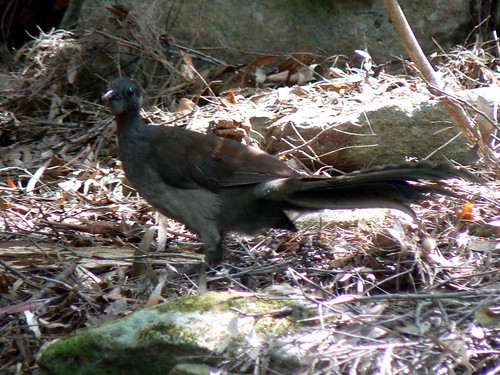
Juvenile male Superb Lyrebird

A Superb Lyrebird, Menura novaehollandiae. It's hard to get a good shot of these, as they're so timid. This one appears to be a juvenile male, with its elaborate tail plumage beginning to develop. There's been a lot of lyrebird courtship going on, with males pursuing females through the garden and wooing with their extraordinary repertoire. I completely forgive them for the damage they do to the garden. Their presence is, well, superb!

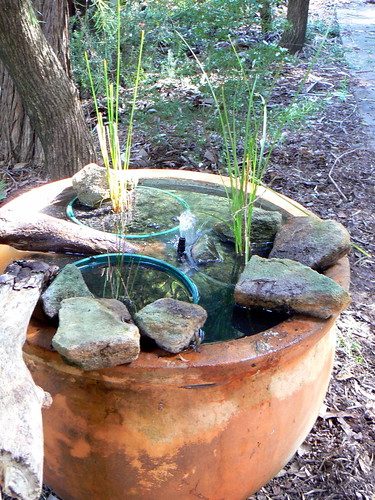
New frog home


In addition to our old pond, we've added another frog habitat: a large, sealed terracotta pot. I've planted some emergent monocots in it, hoping to attract another species of frog, the Eastern Dwarf Green Tree Frog, Littoria fallax. As these plants grow, they'll conceal the plastic pots, and I've planted some densely growing plants around it, to provide protection. The pump is solar powered, with a solar panel on the roof  in one of the few spots at our place that gets regular sunlight.

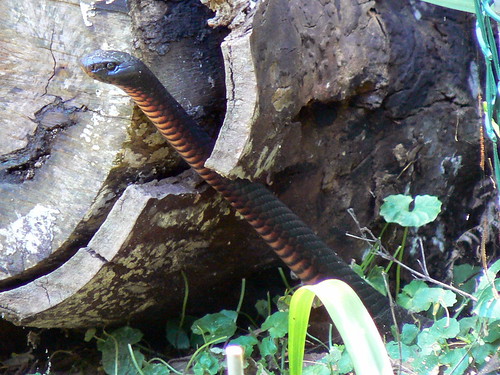
Pseudechis porphyriacus

This is a new visitor to our garden, a Red Bellied Black Snake, Pseudechis porphyriacus. It's around 1.5 metres in length. Although venomous, it's a cautious species and so I'm not too concerned about its presence. The frogs might be though!

My end of year exams will be over in around a month, and I hope to spend lots of time in the garden and blogging, so I'll see you then!

Sunday, January 25, 2009

Superb Lyrebird

As I've previously mentioned, some Superb Lyrebirds, Menura novaehollandiae frequent our garden. They're remarkably beautiful birds, their common name reflecting the the male's tale, which resembles an ornate musical lyre. Even more extraordinary than the plumage, however, is their famous song. Or songs....


Image: John Gould,
The birds of Australia 1840-48


This morning, we were delighted to hear one of the males performing his repertoire. It included the calls of an Eastern Rosella (Platycercus eximius), an Eastern Whipbird (Psopodes olivaceus), an Australian Magpie (Gymnorhina tibicen), a car alarm, the beep of an electronic car-key, and the frogs in the creek behind our house, Crinia signifera.

The Superb Lyrebird is quite large, the male being up to 100cm in length, including tale. They fossick in the leaf litter of moist forests in South-Eastern Australia, eating insects, worms and spiders. They roost in trees at night.

Their mimicry is, of course, all about getting girls. The male builds a mound to act as a stage where he throws his tale over his head, shakes it, and performs for half an hour or more. The complexity of his repertoire is directly proportional to his mating success.

The accuracy of their mimicry has to be heard to be believed, so here is a video of one being interviewed by David Attenborough.