Showing posts with label Platycercus eximius. Show all posts

Sunday, January 25, 2009

Superb Lyrebird

As I've previously mentioned, some Superb Lyrebirds, Menura novaehollandiae frequent our garden. They're remarkably beautiful birds, their common name reflecting the the male's tale, which resembles an ornate musical lyre. Even more extraordinary than the plumage, however, is their famous song. Or songs....


Image: John Gould,
The birds of Australia 1840-48


This morning, we were delighted to hear one of the males performing his repertoire. It included the calls of an Eastern Rosella (Platycercus eximius), an Eastern Whipbird (Psopodes olivaceus), an Australian Magpie (Gymnorhina tibicen), a car alarm, the beep of an electronic car-key, and the frogs in the creek behind our house, Crinia signifera.

The Superb Lyrebird is quite large, the male being up to 100cm in length, including tale. They fossick in the leaf litter of moist forests in South-Eastern Australia, eating insects, worms and spiders. They roost in trees at night.

Their mimicry is, of course, all about getting girls. The male builds a mound to act as a stage where he throws his tale over his head, shakes it, and performs for half an hour or more. The complexity of his repertoire is directly proportional to his mating success.

The accuracy of their mimicry has to be heard to be believed, so here is a video of one being interviewed by David Attenborough.

Wednesday, July 30, 2008

Birds!

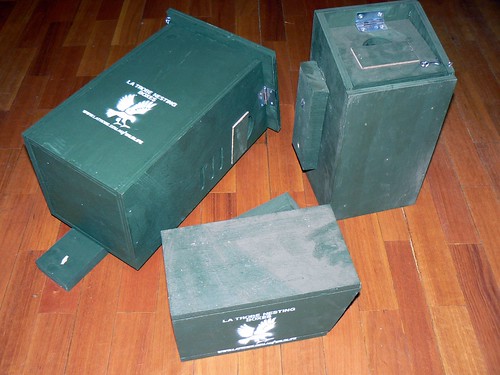
For my birthday (Happy Birthday, me!) my parents gave me some money to spend as I wished, so I ordered three native bird nesting boxes from La Trobe University and they arrived today. Of course, there are plenty of tree hollows out in the National Park and we do have lots of birds visiting our garden, but I'm keen to have them nesting here so we can watch them.

Bird boxes


One's for rosellas or lorikeets; one for large parrots; and one for pardalotes. The parrot boxes both have "exotic bird excluders", the thin pieces of wood partially covering the entrances. Parrots like to chew open entrances to their nests, while exotics can't, and won't fit in. The pardalote entrance is too tiny for other species.

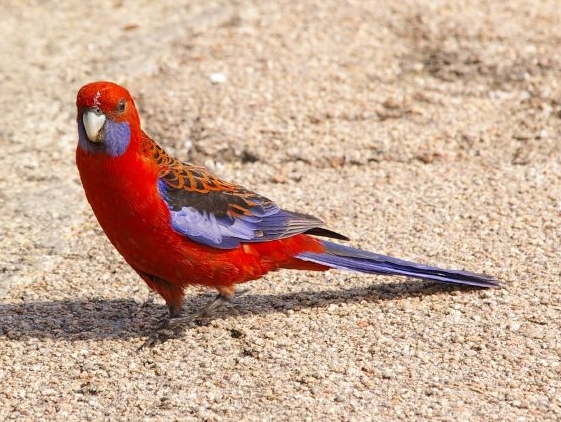
These are the birds most likely to move in, just in case you're unfamiliar with them. I've seen all of them in our garden over the last year.


Yellow-tailed Black Cockatoo,
Calyptorhynchus funereus


Rainbow Lorikeet,
Trichoglossus haematodus


Crimson Rosella, Platycercus elegans


Eastern Rosella, Platycercus eximius


Bird images: Wikimedia Commons.

I'll post images of the boxes in situ, once we've done the ladder thing, and of course post updates when there's avian activity.