Showing posts with label Allocasuarina littoralis. Show all posts

Friday, July 03, 2009

Germination

In May, I collected some seeds, including Hakea sericea and Allocasuarina littoralis. They have now germinated, and what pretty little things they are.

In both cases, the contrast between the cotyledons (embryonic leaves) and the first "true leaves" is stark. In dicotyledons, the two cotyledons form inside the embryo inside the seed and emerge after germination. They are soon replaced by leaves that are much closer in structure to those of the mature plant.


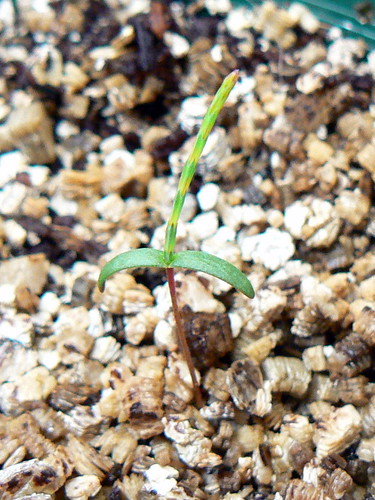
Allocasuarina littoralis seedling

In the Allocasuarina littoralis, the small scale-like leaves are already visible along the main stem. The specimen above is around 3 cm tall.


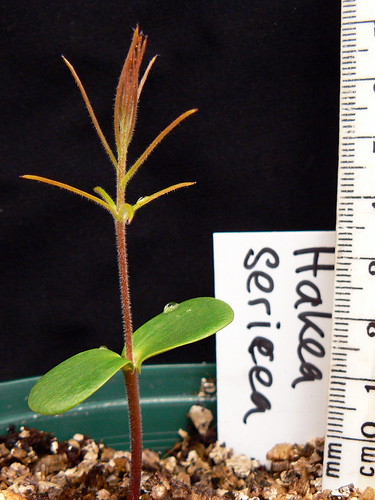
Hakea sericea seedling

The true leaves of the Hakea sericea display the sharp needle-like structure of mature leaves, but are still very soft in comparison with the brutal barbs it'll have when it grows up.

When all the seedlings have reached around 10 cm in height, I'll pot them up into tube stock tubes, and move them out of the glass house, and put them into the shade house. That will give them time to harden up in a relatively sheltered environment, and perhaps be ready to go in the garden by next autumn.

Saturday, May 30, 2009

Kitchen Bench Propagation

Pottering in the garden on a weekend is great when it's fine, but today it's raining so I did my gardening in the kitchen, propagating the seeds I recently collected as well as doing some cuttings from plants in the garden.

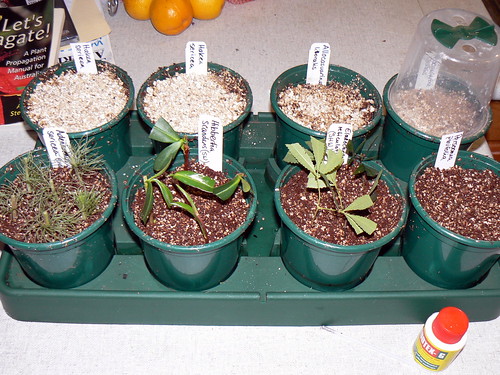
Propagation tray


This tray is something I picked up a few years ago, and it is brilliant for propagating both seed and cuttings. The pots have lids (see top right) that allow you to keep the seedlings or cuttings protected, as well as regulating water loss. The pots sit on sponges which you keep wet, and the soil draws up moisture as needed.

So the Allocasuarina littoralis and Hakea sericea seeds you might remember from my previous post. I've made cuttings of three other plants:

The first is Adenanthos sericea, Albany Woolly Bush, a West Australian species I'm growing in a pot. It's getting a bit large for the pot and a little tired, so some offspring are timely. As you can see from the photos in the link above, it looks like its leaves should be sharp and tough like those of Hakea sericea, but in fact they're soft and delicate. It's a very beautiful shrub/tree.

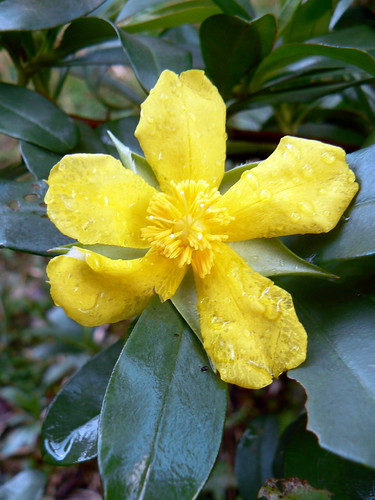
Next is Hibbertia scandens, a local twiner which propagates from cuttings very easily. It flowers year round--I took this photo this afternoon.

Hibbertia scandens

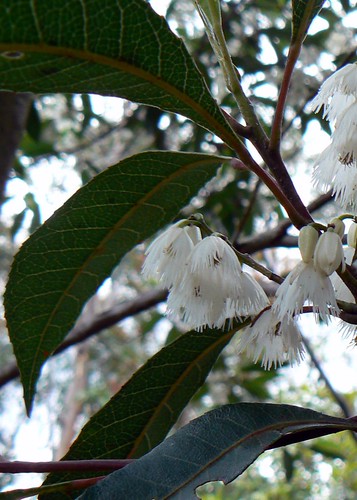
And finally, Elaeocarpus reticulatus, Blueberry Ash, which produces either white or pink flowers and bright blue berries, beloved of birds. As you can see, we have the white flowered variety.

Elaeocarpus reticulatus.

All these cuttings are semi-hardwood. That means it's not the most recent growth, nor old growth, but something in between that still has vigor but is more substantial than the new growth used in soft-tip cuttings. Autumn is the best time for semi-hardwood cuttings.

As a propagating mix, I used 1:1 peat moss and vermiculite, a quite versatile and handy mineral that assists in ensuring that the growing medium is well aerated. I also use it to cover seeds when they're sown, to gently hold them down and keep them moist.

When you're making cuttings, it's important to make your final cut at the bottom just below a node. The node is where the meristematic tissue is--basically, the same as embryonic stem cells in humans, able to differentiate into a variety of cell types. When you're doing cuttings, you want them to become root cells.

It's also wise to remove most of the leaves, and cut half to two thirds off the remaining. Some leaves are needed so the plant can still photosynthesise, but plants transpire (lose water) through their leaves, and for a plant with no roots, water is at a premium. For the same reason, you need to keep their environment humid.

Humidity, of course, brings its own problems, mainly in the form of fungal infection. Whenever I propagate with cuttings or seeds, I first wash all my pots in a dilute solution of bleach, then rinse. "Damping off" is a form of fungal disease that can easily kill tiny seedlings, the stems essentially being eaten away.

To give your cuttings a high chance of success, rooting hormone is a good idea. This is basically auxin, a plant hormone. Auxin's quite remarkable stuff. It is found in the shoot and root tips of plants, and its presence there ensures that tip's dominance, and suppresses the growth of competitors. When you remove the main shoot of a plant (by tip pruning, for example), that suppression ceases, and the apical buds in the nodes (near where the leaves attach to the stem) then begin to grow new shoots. Thus by tip pruning, you can make your plant nice and bushy, especially if you begin tip pruning when they're still very young . Applying auxin to the basal cut of a cutting stimulates root growth there--especially if it's just below a node.

Now I know you're just aching to know how the dreaded Persoonia pinifolia seeds I talked about last post are coming along. Hmm. Not great.

Having soaked them for a couple of days, I tried breaching the endocarp, and succeeded in cutting the embryo in half. Whoops. This photo shows just how solid and relatively thick the endocarp is!
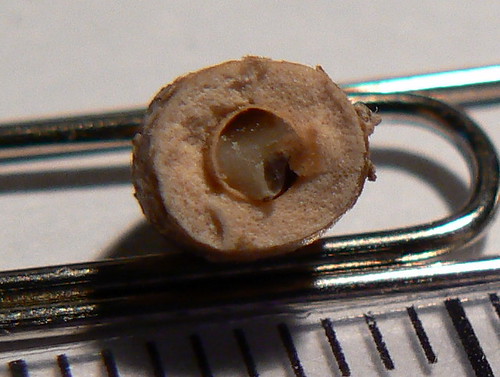
Persoonia pinifolia endocarp and embryo
Scale: 1mm.

There were three seeds left, but I stupidly left them on the kitchen counter in a bowl. My husband just got home and cleaned up.... Well, we rescued two from the sink. This is clearly the downside of kitchen bench propagation.

I'm going to attempt to file off the endocarps. I may be gone for some time....

Edited to add: If you're interested in propagating native plants, I couldn't recommend this book more highly. Angus Stewart's "Let's Propagate: A Plant Propagation Manual for Australia". Not only does he provide good advice on methods, he also has a comprehensive listing of Australian plant genera, and what method works best with each.
Monday, May 18, 2009

Seeds

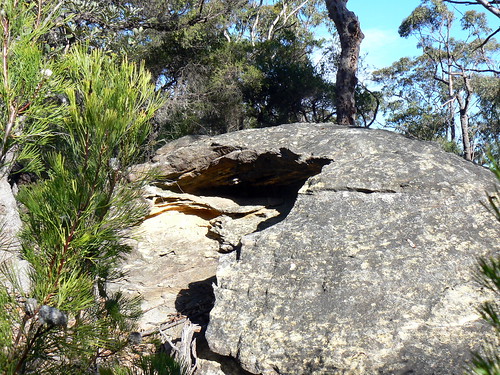
A couple of days ago, we went for a walk in the Berowra Valley Regional Park near our home, and I collected a few seeds of local plants for propagating. It's a stunning nature reserve situated on the Hawkesbury Sandstone Plateau from the Middle Triassic period, and has a great variety of flora.

Sandstone in Berowra


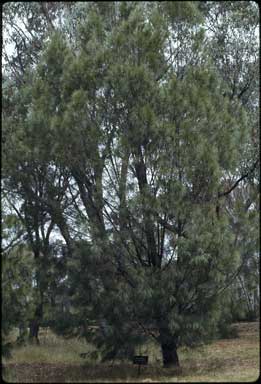
One of the trees common to our local sclerophyll forests is Allocasuarina littoralis, Black Sheoak:

Image: Australian National Botanic Gardens

It superficially resembles a pine, especially given its needle-like "leaves", but closer inspection shows that they are not leaves at all.

Allocasuarina littoralis leaves
Scale: 1mm

In this photo, you can see two sets of the tiny, tooth-shaped leaves on the modified stem. The shape and number of these leaves is key to identifying the species within the genus. The leaves are minute, scarcely visible to the human eye, and clearly it is the stem that is responsible for the plant's photosynthesis. The similarity at first glance to pines is, in fact, an example of convergent evolution. The major difference between pines and members of the family is that while pines are conifers, the family Casuarinaceae are angiosperms: flowering plants.

Allocasuarina littoralis is dioceous, meaning that male and female sexual parts occur on separate trees. Thus at this time of year, roughly half will be in fruit--the females. They flower in spring, with reddish flowers on the females, and dark brown flowers on the males.

After collecting the fruits, I cajoled them to open and release their seed in accordance with the ancient custom: putting them in a paper bag and leaving them on the dashboard of the car for a couple of days. Even in relatively cool weather, this heats them sufficiently for them to open.

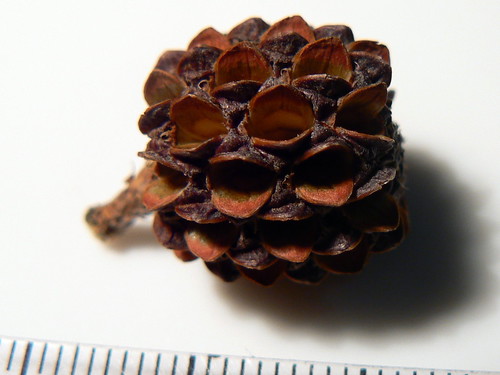
Here is a fruit, opened up:

Allocasuarina littoralis fruit

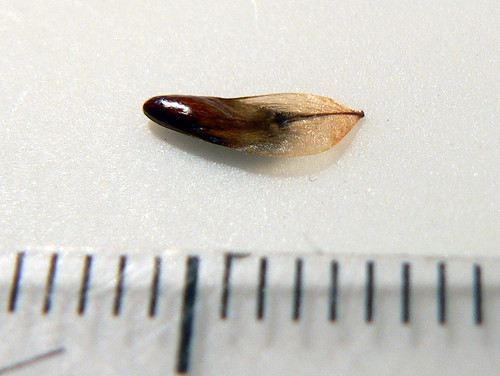
And here is a seed:

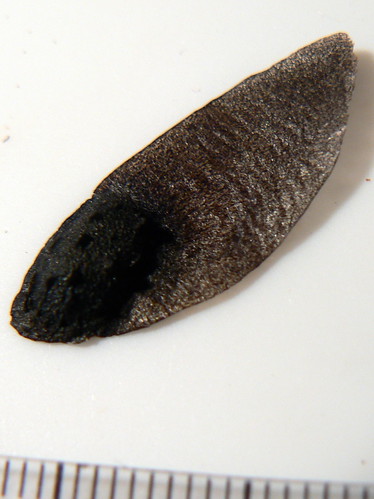
Allocasuarina littoralis seed

The gossamer wing on the right side of the seed is its samara, quite common in plants that use wind for the seed dispersal.

A far more spectacular seed and fruit comes from Hakea sericea, a member of the Proteaceae family. It's remarkable to realise that from these delicate flowers...

Hakea sericea

...will develop to become these large, woody fruits...

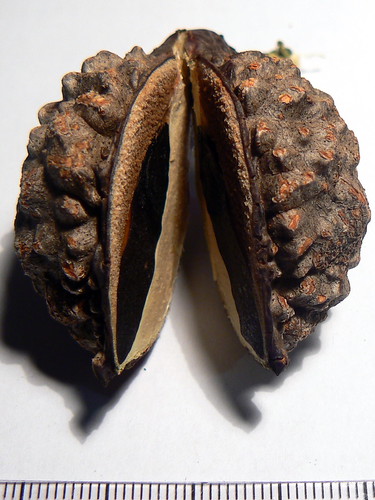
Hakea sericea fruit

This fruit has split open, again by means of the car dashboard. The two black seeds are visible inside.

Hakea sericea seed

Like the seed of the Allocasuarina, the much larger Hakea seed also has a samara. That the fruit is so large and solid, and in terms of production, energy-expensive, can perhaps be explained by the fruit remaining closed until the shrub dies or until it is consumed by fire. It might have to protect the seeds for many years before it is time for them to germinate. Hakea leaves are perilously prickly and hard. Falling onto one would not be fun.

I'll be germinating the seeds from both species shortly, and will follow their growth and development here. There are few things more satisfying than growing plants that are indigenous to your own region, knowing that they'll fit perfectly into the ecosystem of your garden!

Friday, January 09, 2009

Calyptorhynchus lathami -- Glossy Black-Cockatoos

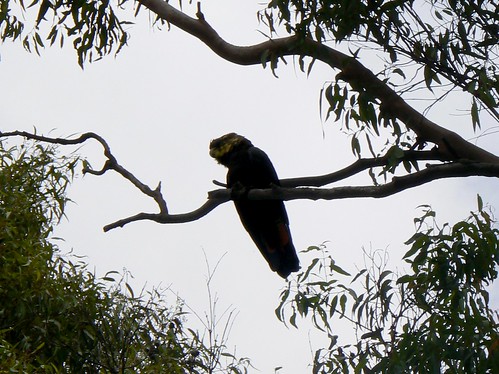
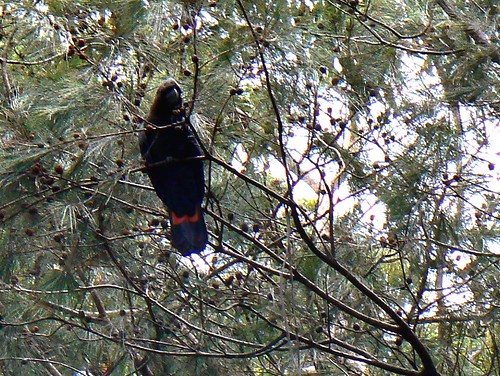
I just took these shots (not the best, but the birds were high up!) of Glossy Black-Cockatoos in our garden. They were a family with a squawking baby, feeding on the fruits of an Allocasuarina, their preferred diet.

Calyptorhynchus lathami (female)

Calyptorhynchus lathami (male--I think)

Calyptorhynchus lathami is variously listed as threatened and vulnerable, in large measure because its Allocasuarina habitat has been substantially reduced.

The female has irregular yellow blotches on her head and a red tail panels, while the male lacks the yellow and has less red on the tail. According to Simpson and Day's Field Guide to the Birds of Australia, the species can be both nomadic and sedentary, and their description of the call, "soft, wailing 'tarr-red'," certainly seems accurate.

I've planted a number of Allocasuarina in the garden to supplement the mature specimens already here, so I hope the Glossy Blacks will long find our home a good haven and she-oak restaurant.