Showing posts with label Persoonia pinifolia. Show all posts

Saturday, May 30, 2009

Kitchen Bench Propagation

Pottering in the garden on a weekend is great when it's fine, but today it's raining so I did my gardening in the kitchen, propagating the seeds I recently collected as well as doing some cuttings from plants in the garden.

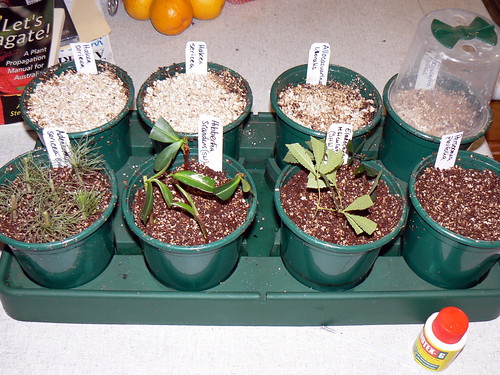
Propagation tray


This tray is something I picked up a few years ago, and it is brilliant for propagating both seed and cuttings. The pots have lids (see top right) that allow you to keep the seedlings or cuttings protected, as well as regulating water loss. The pots sit on sponges which you keep wet, and the soil draws up moisture as needed.

So the Allocasuarina littoralis and Hakea sericea seeds you might remember from my previous post. I've made cuttings of three other plants:

The first is Adenanthos sericea, Albany Woolly Bush, a West Australian species I'm growing in a pot. It's getting a bit large for the pot and a little tired, so some offspring are timely. As you can see from the photos in the link above, it looks like its leaves should be sharp and tough like those of Hakea sericea, but in fact they're soft and delicate. It's a very beautiful shrub/tree.

Next is Hibbertia scandens, a local twiner which propagates from cuttings very easily. It flowers year round--I took this photo this afternoon.
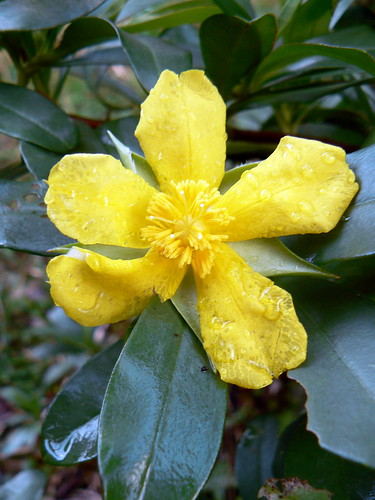
Hibbertia scandens

And finally, Elaeocarpus reticulatus, Blueberry Ash, which produces either white or pink flowers and bright blue berries, beloved of birds. As you can see, we have the white flowered variety.
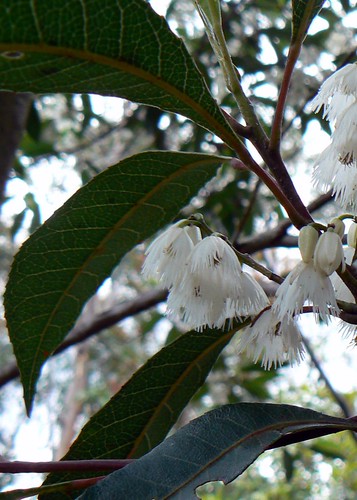
Elaeocarpus reticulatus.

All these cuttings are semi-hardwood. That means it's not the most recent growth, nor old growth, but something in between that still has vigor but is more substantial than the new growth used in soft-tip cuttings. Autumn is the best time for semi-hardwood cuttings.

As a propagating mix, I used 1:1 peat moss and vermiculite, a quite versatile and handy mineral that assists in ensuring that the growing medium is well aerated. I also use it to cover seeds when they're sown, to gently hold them down and keep them moist.

When you're making cuttings, it's important to make your final cut at the bottom just below a node. The node is where the meristematic tissue is--basically, the same as embryonic stem cells in humans, able to differentiate into a variety of cell types. When you're doing cuttings, you want them to become root cells.

It's also wise to remove most of the leaves, and cut half to two thirds off the remaining. Some leaves are needed so the plant can still photosynthesise, but plants transpire (lose water) through their leaves, and for a plant with no roots, water is at a premium. For the same reason, you need to keep their environment humid.

Humidity, of course, brings its own problems, mainly in the form of fungal infection. Whenever I propagate with cuttings or seeds, I first wash all my pots in a dilute solution of bleach, then rinse. "Damping off" is a form of fungal disease that can easily kill tiny seedlings, the stems essentially being eaten away.

To give your cuttings a high chance of success, rooting hormone is a good idea. This is basically auxin, a plant hormone. Auxin's quite remarkable stuff. It is found in the shoot and root tips of plants, and its presence there ensures that tip's dominance, and suppresses the growth of competitors. When you remove the main shoot of a plant (by tip pruning, for example), that suppression ceases, and the apical buds in the nodes (near where the leaves attach to the stem) then begin to grow new shoots. Thus by tip pruning, you can make your plant nice and bushy, especially if you begin tip pruning when they're still very young . Applying auxin to the basal cut of a cutting stimulates root growth there--especially if it's just below a node.

Now I know you're just aching to know how the dreaded Persoonia pinifolia seeds I talked about last post are coming along. Hmm. Not great.

Having soaked them for a couple of days, I tried breaching the endocarp, and succeeded in cutting the embryo in half. Whoops. This photo shows just how solid and relatively thick the endocarp is!
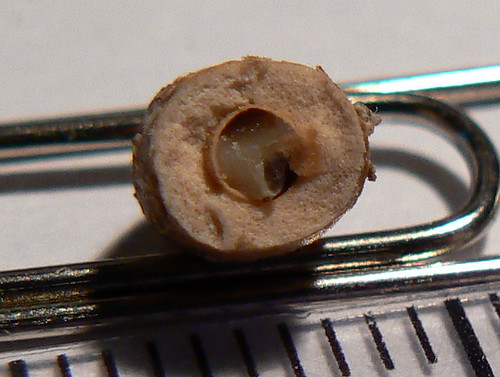
Persoonia pinifolia endocarp and embryo
Scale: 1mm.

There were three seeds left, but I stupidly left them on the kitchen counter in a bowl. My husband just got home and cleaned up.... Well, we rescued two from the sink. This is clearly the downside of kitchen bench propagation.

I'm going to attempt to file off the endocarps. I may be gone for some time....

Edited to add: If you're interested in propagating native plants, I couldn't recommend this book more highly. Angus Stewart's "Let's Propagate: A Plant Propagation Manual for Australia". Not only does he provide good advice on methods, he also has a comprehensive listing of Australian plant genera, and what method works best with each.


Wednesday, May 20, 2009

Persoonia pinifolia seed propagation... I hope!

Persoonia pinifolia is a notoriously difficult species to propagate by seed. So I've set myself the challenge!


Also known as the Pine-leaved Geebung, this species of shrub is indigenous to a small region of Australia, between Broken Bay to the Royal National Park and the lower Blue Mountains. The difficulty in germinating appears to be caused by the hard, dense endocarp surrounding the seed embryo.


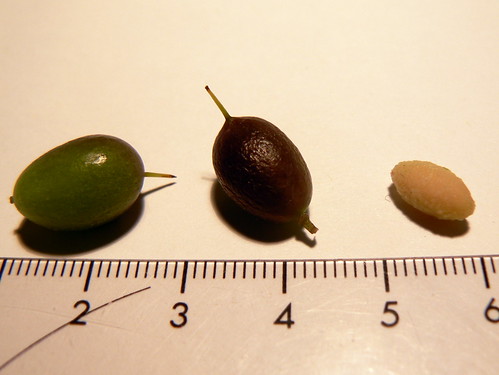
Persoonia pinifolia seeds

On the left, is an unripe fruit (a drupe), as I collected it from the shrub. In the centre, a ripened drupe. I facilitated the ripening by keeping it in a paper bag along with a ripe banana for a few days. Bananas when mature release the gas ethylene, which is an important plant growth hormone. (If you have a bunch of bananas that aren't ripe, and you put them in a bag with a ripe banana, all will ripen quickly. Handy, huh?)

On the right is a seed with the flesh of the drupe--the seed's exocarp--removed. What you can see is the endocarp, and inside that is the embryo.

Many species of seed need to have their endocarp breached in some way to allow the influx of water and oxygen so the embryo can germinate. There are many ways of doing this, depending on species and their evolution. Sometimes, the seed is placed in boiling water, as with Acacia seeds. Another methods include abrading or piercing the endocarp, or burning the seed. Seed dormancy can also be overcome by stratification (chilling) in the case of seeds from alpine and semi-alpine habitats, or by the application of water through which smoke has been bubbled.

Just about everything has been attempted on Persoonia seeds by various horticulturists and plant scientists, without much success. One paper, "Propagation of Persoonia virgarta for the development of a new floricultural export crop," by Lynda Maree Bauer (ne Ketelhohn) and Margaret Johnston of the University of Queensland, suggests that one of the major factors inhibiting germination is the sheer hardness of the endocarp. Merely abrading or piecing it is insufficient, suggesting that there is in part a simple mechanical barrier to seed growth.

So taking their research as my guide, I am going to try to break down the endocarps. Having removed the exocarps, I'm now soaking the seeds in water in an attempt to soften the endocarps by fermentation, and then will use pliers to remove them. The risk here, of course, is that I damage the embryos, and there is also a real possibility of contamination by bacteria or fungi.

Thus it might all end up in a heap of failure, but it's worth a try. If I don't succeed, the next step will be to try propagating Persoonia pinifolia by cuttings. Apparently that's not always successful, but more efficacious than by seed. Watch this space!

Friday, January 04, 2008

The Great Regeneration Project

There is a section of our front garden which some people might consider potential "lawn" (ugh, spit!) or just a big pile of weeds. But it holds treasures within. It's not so long since it was bushland, so the soil still contains seeds of the original flora either dormant or recently dispersed, and there are tiny seedlings struggling to find their way out of the invasive plants (both exotic and native) covering them.


The "regen zone". In the foreground is a Telopea
speciosissima (red Waratah). The other species I've planted
are mainly Allocasuarina spp, Eucalyptus spp, and Acmena smithii
(lillypillies). There remain some exotics, including Camellia. I'll
be removing them when their replacements are a little larger.


Today, my friend from the Herbarium, Peta Hinton came for lunch and we spent the afternoon combing the garden looking for seedlings, and removing weeds around them to give them a chance. It'll be a long process, but with patience, we'll let the local flora return to its rightful place. Peta is a veteran bush regenerator and has bogglingly good skills at spotting and identifying native flora when it's barely past the cotyledon stage.

We found an amazing array of seedlings:

Proteaceae:

  • Grevillea sericea
  • Persoonia pinifolia
  • Banksia oblongifolia

Fabaceae

  • Acacia spp.
  • Pultenaea daphnoides
Myrtaceae
  • Angophora costata
  • Kunzia ambigua

Asteraceae

  • Ozothamnus diosmifolium

Euphorbiaceae

  • Poranthera microphylla

Orchidaceae

  • Cryptostylis subulata
  • Cryptostylis erecta

Apiaceae

  • Xanthosia pilosa
  • Platysace linearifolia

On the upper left, are two seedlings close together. One is an
Angophora costata, the other an identified Acacia species.
On the right, a Grevillea sericea.


I knew that I had some more terrestrial orchids in the front yard, but until today, didn't know what they were. Now one's flowered and demonstrated itself to be Cryptostylis erecta. There are many yet to flower in this part of the garden, but I'm hoping that when they've got some space, they'll take off too. So now we've got two species of the Cryptostylis genus, this and the Cryptostylis subulata I posted about previously.

Cryptostylis erecta


So, as New Year Resolutions go, this, I think, is a good one. To get the weeds under control and nurture the babies.

Happy new year!