Friday, October 29, 2010

Aw.

I am up to my earballs in uni work/study at the moment and have been deliberately ignoring this poor forsaken blog, but couldn't resist posting this.

In our backyard, this evening.


Swamp Wallaby, Wallabia bicolor, with joey. (Happily, they were eating weeds.)

Friday, September 17, 2010

Department of Biology... Open Day 2010

I thought I'd play with Flickr's slideshow embedding function. Rather cool, I think!

These photos are from Macquarie University's Open Day earlier this month:
  • Jonno and his Eclectus parrots, Eclectus roratus. Interesting sexual dimorphism, probably related to their polygyny: the female is red, and the male green. 
  • Adam Stow with an Olive python: Liasis olivaceus. Adam is a conservation geneticist and my supervisor for my 2010 Advanced Biology Internship.
  • Prospective students exploring geekery in one of our teaching labs.
  • Queuing for fairy floss: Macquarie University Biological Society rots the teeth of prospective students.
  • Pteropus poliocephalus, a grey-headed flying fox (fruit bat).
  • A mantis eats a cricket.
  • A couple more photos of the Olive python, including one with its very close friend Siobhan. 
  • Tawny Frogmouth: Podargus strigoides, doing its stump impersonation.
  • Green tree frog: Litoria caerulea.
  • Blue tongue lizard: Tiliqua scincoides scincoides.
  • MUBS friends Eleanor and Renee with a St Andrew's Cross Spider, Argiope keyserlingii


Saturday, August 28, 2010

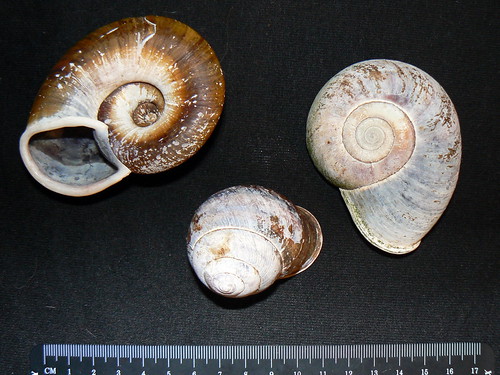
Monster Rainforest Snails

I've just cleaned and photographed three snail shells that I found in the rainforest floor in Bulburin. Shortly I hope to have an identification of them, and will post the results here. In the meantime, gaze in wonder!

Snail shells


As you can see from the scale, these are mighty molluscs. The largest shell is 84 mm in length.

Friday, August 27, 2010

Adventures in a subtropical rainforest: Part 5

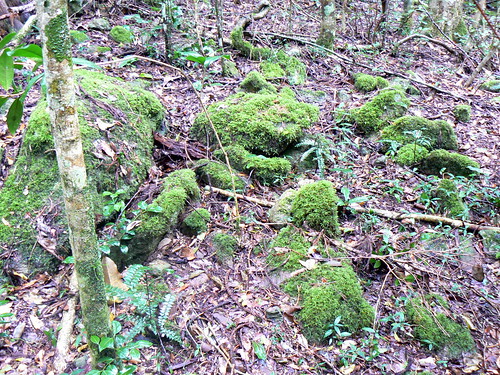
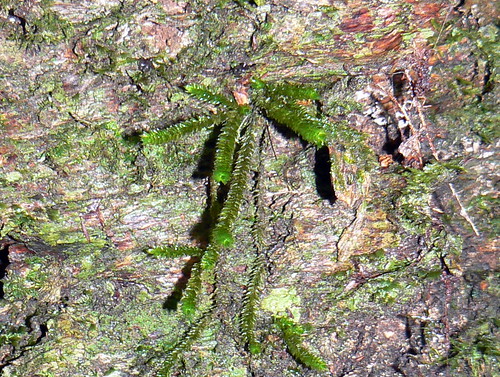
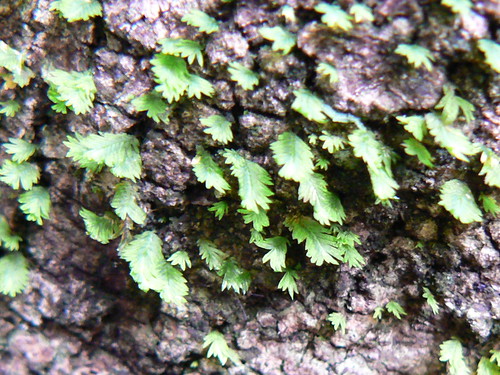
In the final post of this series, some mosses of the subtropical rainforest. Mosses are plants that evolved well before the flowering plants (angiosperms), conifers and ferns. They have lack a vascular system, which means that they require constant moisture to avoid desiccation. Mosses reproduce by way of spores rather than seeds and have a fascinating life cycle in which haploid and diploid generations alternate.
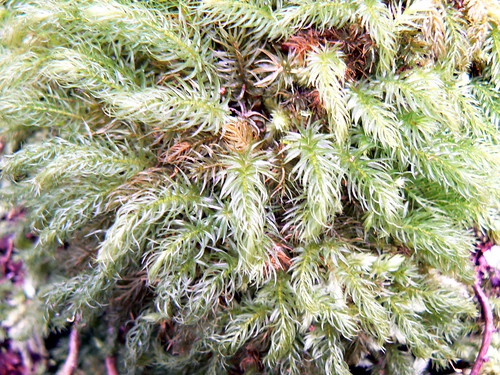
Moss on rainforest floor

Moss on forest floor


Moss on trunk


Before I sign off from this spate of posts, here's a mystery. These worms, which essentially resembled earthworms (phylum Annelida) were at around chest height. They appeared to be dead, but recently so. Any thoughts as to what they were doing there, and how they got there? I'm flummoxed!
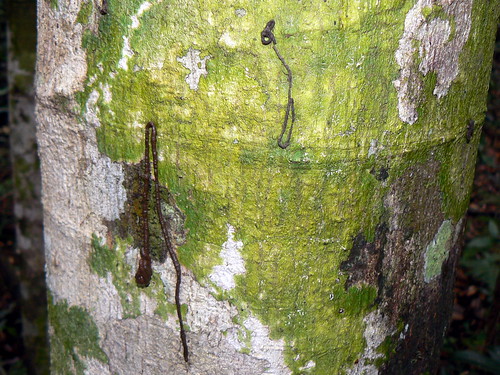
Worms on trunk
Why am I here?