The warm weather is really bringing out the insects! I took this photo of a male mantid a couple of nights ago.
The mantid was on the ceiling (hmm, needs cleaning) when I shot this while precariously standing on a chair. (The image has been inverted.) Mantids are from the Order Mantodea, and are excellent predators of other invertebrates.
This photo is of a female, shot through a window (hmm, also needs cleaning). It's eating a beetle.
Here's another female, resident of Macquarie University Biology Department:
My daughter has a growing interest in insects, and is planning to keep a mantid as a pet. So expect many more photos of these gorgeous creatures!
Friday, December 18, 2009
Thursday, December 03, 2009
The Bird and the Spider.
No particular theme today, but two animals that caught my fancy.
The first is a black house spider, Badumna insignis. It's a common sight in Australian gardens and houses. While not too dangerous, it is poisonous and can badly affect sensitive folk. I'm trying to improve my skills in photographing arthropods, but it isn't easy! Focus, lighting....
The second species is becoming a frequent visitor to Sydney gardens, particularly since baiting of foxes (one of Australia's many mammal weeds!) is starting to take effect. While brush turkeys (Alectura lathami) are well known for foraging in mulch, building mounds in inconvenient spots and generally causing general garden chaos, few realise that at night they roost in trees. That our garden is a popular place for them to roost is evidenced by the chunky piles of brush turkey poo we regularly find on our car.
I just took this shot, at dusk. It's remarkable that such a large bird (weighing around just under 2 kg) can roost so happily on what are really quite narrow branches.
Here's one I prepared earlier:
Sunday, November 29, 2009
Angophora costata
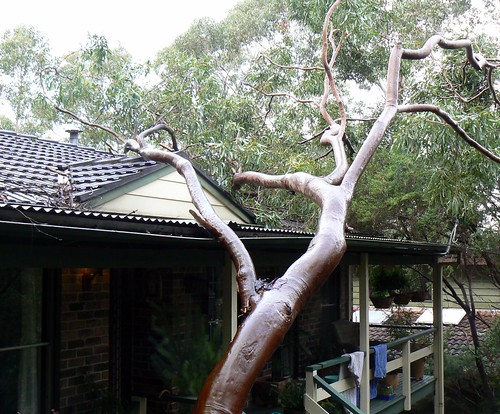
The Sydney Red Gum, Angophora costata, is a particularly beautiful tree, especially in spring when its normally smooth bark flakes away to expose the new season's pinky-grey bark beneath.

Angophora costata is found across a range of eastern coastal regions in Australia, and they are common in the sandstone soil of the Hawkesbury area. They are not of the genus Eucalyptus, but are closely related. One way to distinguish them is that Angophora leaves grow opposite each other on the stem, while in Eucalyptus species they alternate.

We have a few mature specimens in our garden, and they provide shade and habitat for a multitude of creatures. Their heavy limbs also have a tendency to shatter, alas. Just over two years ago, a large tree fell over on our house.
I recently bought a pair of earrings made from A. costata leaves. The leaves were treated with acid, removing all leaf tissue but the skeleton, and then dipped in gold. It's not easy to see from this photo, but against the light you can see the filigree pattern. Ideal for a planty person's lobes!

Angophora costata is found across a range of eastern coastal regions in Australia, and they are common in the sandstone soil of the Hawkesbury area. They are not of the genus Eucalyptus, but are closely related. One way to distinguish them is that Angophora leaves grow opposite each other on the stem, while in Eucalyptus species they alternate.

We have a few mature specimens in our garden, and they provide shade and habitat for a multitude of creatures. Their heavy limbs also have a tendency to shatter, alas. Just over two years ago, a large tree fell over on our house.
Wednesday, November 11, 2009
Fauna less loved: bloodsuckers.
I often wax lyrical in this blog about the flora and fauna in our garden, but some species are less welcome than others. Here are a couple of invertebrates that can make gardening a little hazardous.
This is a paralysis tick, Ixodes holocyclus. It's only tiny when it hasn't been feeding: this specimen is only 1.5mm in body length.When they're engorged with blood, they increase in size by many times.
Ixodes holocyclus is indigenous to the east coast of Australia, and its food source is primarily the blood of marsupials such as wallabies, bandicoots and possums. Domestic cats and dogs are particularly vulnerable to them in bushland areas, and without treatment can die. Human fatalities have become far less common since the development of an anti-toxin.A couple of months ago, a paralysis tick made its way into my bra, and injected me with its toxin. By next day, the inflammation on my breast (lovely soft flesh--a tick's delight!) was the size of a saucer, raised, hot and very painful. It took a course of antibiotics, antihistamines, steroid cream and many sleepless nights before it subsided.
Ticks are in the class Arachnida, like spiders and scorpions, and thus have eight legs.
While waiting for prey, the leech anchors itself by its posterior sucker and raises its body up. It senses potential victims by vibrations and chemical sensing, and attaches to the skin by its mouth. Then it injects anticoagulants and histamines to stop the blood from clotting and allow it to flow freely into the leech. Amazingly, it's easy to miss that a leech has attached to you. It's only after it's full and drops off to digest your precious bodily fluids, that you notice the itch---and the blood freely pouring out of the wound. If you're prone to allergies, like me, a nasty hot, itchy welt can develop.
Much as I loathe their effect, I do have a grudging admiration for leeches. They mark a significant evolutionary development from less derived species, because their body segmentation improves their mobility--something very evident when you watch one weaving through the air after it's sensed your presence. Leeches are hermaphrodites, and cross-fertilise during sex. In the phylum Annelida, they are related to common garden worms, but most of their near relatives are marine.
Next time, friendlier species, I promise!
This is a paralysis tick, Ixodes holocyclus. It's only tiny when it hasn't been feeding: this specimen is only 1.5mm in body length.When they're engorged with blood, they increase in size by many times.
Ixodes holocyclus is indigenous to the east coast of Australia, and its food source is primarily the blood of marsupials such as wallabies, bandicoots and possums. Domestic cats and dogs are particularly vulnerable to them in bushland areas, and without treatment can die. Human fatalities have become far less common since the development of an anti-toxin.A couple of months ago, a paralysis tick made its way into my bra, and injected me with its toxin. By next day, the inflammation on my breast (lovely soft flesh--a tick's delight!) was the size of a saucer, raised, hot and very painful. It took a course of antibiotics, antihistamines, steroid cream and many sleepless nights before it subsided.
Ticks are in the class Arachnida, like spiders and scorpions, and thus have eight legs.
Another bloodsucker frequenting our garden is the leech. The species below is (most likely) the Australian Land Leech, Gnatbobdellida libbata, which has evolved to live out of water, and becomes active after rain.
While waiting for prey, the leech anchors itself by its posterior sucker and raises its body up. It senses potential victims by vibrations and chemical sensing, and attaches to the skin by its mouth. Then it injects anticoagulants and histamines to stop the blood from clotting and allow it to flow freely into the leech. Amazingly, it's easy to miss that a leech has attached to you. It's only after it's full and drops off to digest your precious bodily fluids, that you notice the itch---and the blood freely pouring out of the wound. If you're prone to allergies, like me, a nasty hot, itchy welt can develop.
Much as I loathe their effect, I do have a grudging admiration for leeches. They mark a significant evolutionary development from less derived species, because their body segmentation improves their mobility--something very evident when you watch one weaving through the air after it's sensed your presence. Leeches are hermaphrodites, and cross-fertilise during sex. In the phylum Annelida, they are related to common garden worms, but most of their near relatives are marine.
Next time, friendlier species, I promise!
Subscribe to:
Posts (Atom)