Tuesday, February 19, 2008

A Room of One's Own.

Virginia Woolf wrote about it nearly a century ago: the importance of having a room of one's own. She was writing specifically for women, who rarely had such a luxury at the time. Perhaps too few of us have one still.

But I do. I now have the room I've dreamed of for years. I have my books, some beautiful furniture, prints on the wall, plants, my desk, my computer (sorry Virginia, a bit of a shock, I imagine), my music and my microscopes surrounding me. I have a place I love, a place of stillness to allow thought and ideas and study.

The Books

I won't post the rest of the photos of the transformation and the (almost--a rug and curtains remain to be furnished) finished product, but you can see the slideshow here. (Put your cursor on the first photo and click on the i, to get my comments.)

Happily yours,

M.

Saturday, February 09, 2008

Where in the Gardening World are YOU?

This is a question being asked of gardening bloggers across the world by Blooming Writer. So I thought I'd join the fray.

I am on the northern outskirts of Sydney, in the botanical district of Australia's NSW Central Coast. It's a temperate climate here, not too hot, not too cold. For certain definitions of hot and cold that is.... I consider below 15C to be too cold, and over 30C to be too hot. As with most of the continent, I live in place of droughts and flooding rains...
I love a sunburnt country,
A land of sweeping plains,
Of ragged mountain ranges,
Of droughts and flooding rains.
I love her far horizons,
I love her jewel-sea,
Her beauty and her terror
The wide brown land for me!
Dorothea Mackellar.

My garden might have no rain for months, but then be inundated, as it is being currently, with close to 200 mm over the last few weeks. Sydney doesn't do rain gently. When it rains, it buckets down, often with furious electrical storms. Having trees fall over is commonplace here.

As is, alas, bushfire. When we bought this place a year ago, the beautiful bushland of Ku-ring-gai National Park at our back boundary was blackened. Terrifying, disheartening. But now, it's green again. For this flora is evolved to live with fire. Indeed, without fire, much of it cannot regenerate. It's a tough environment and one that non-Indigenous Australians are only lately coming to adapt to.

So, my garden? Well, it's only recently mine. I am so aware of its longevity. White folk moved here only around 150 years ago. There are trees in the garden that well predate European colonisation. Along the side of the house is an Aboriginal shell midden. That this land was taken from Aborigines quite recently--we are talking, after all, about a culture that has existed for around 60,000 years, longer than any other continuous culture on the planet--that this land that owned them is something that we now "own", is something that constantly resonates with me and informs me as I till the soil.

When we moved in, there were many introduced species, some of which were frankly weedy. But of course, what is weedy to an Australian botanist/ecologist/horticulturist is a lovely and easy to grow plant to your average gardener. The latter is an attitude that is changing, but too slowly. I was deeply affronted that anyone who chose to live in a house adjoining one of Australia's most remarkable national parks could contemplate planting things from the other side of the world, but there you are. I guess they didn't know about the propensity of introduced plants to escape and naturalise. Or, more baffling to comprehend, they didn't care.

And so, finally, to what I'm doing in this place. First and foremost, I'm removing the exotics. I'm not doing this as quickly as I'd like, because if I took out all the Camellias, we'd lose a lot of our privacy. (This just boils my blood. The previous owners apparently removed the rows of lillipillies along the driveway--probably Acmena smithii--and replaced them with Camellias. Why, I'll never know. The lillipillies were home to ring-tail possums. The Camillias are home to nothing but invasive Noisy Miners. An example of their intrusion elsewhere in Australia is here.)

And more bloody agapanthus than you could poke a stick at. They're horrors to remove, and seriously invasive in bushland adjoining suburban regions.

Okay, I'm letting my passion get away with me here. Back on topic...! Removing the weedy plants allows the seedbank in the soil to have a chance. So I'm doing a lot of that. And I'm planting many indigenous species, some of which I'm propagating myself. My goal is, essentially, to reproduce the original bushland, but to mold and sculpt it to my vision of garden beauty. I love semi-formal gardens. Structure, but not to the point of squishing the nature out of nature.

It's a very long term plan. Some of the trees I've planted won't reach maturity till long after I'm gone, but that's part of the joy of gardening.

As Vita Sackville-West wrote, "Gardening is a way of showing that you believe in tomorrow." It doesn't really matter if you won't be there tomorrow. The plants will.

Thursday, February 07, 2008

Fern Propagation

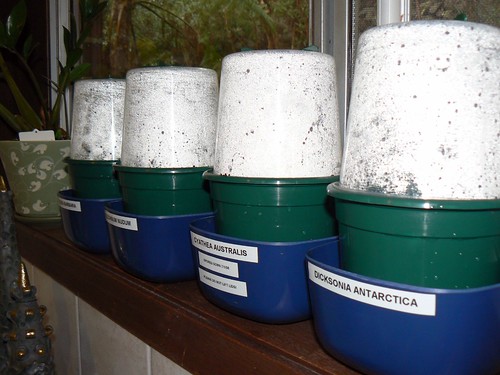
I've started up some fern propagation in my bathroom along the window ledge. It's brightly lit and warm there but at this time of year it gets no direct sunlight, which is pretty much ideal.

Fern Propagation


The spores I've sown are of:

Dicksonia antarctica Soft Tree Fern, grows to 4.5 m high.
Cyathea australis Rough Tree Fern, grows to 20 m high.
Blechnum nudum Fishbone Water Fern, trunk to 1 m.
Todea barbara King Fern, trunk to 3 m, fronds to 2.5 m.

All are indigenous to my region. It's a long and tricky process to grow ferns from spores, and I've not succeeded in the past--probably because I let the medium dry out. If this lot make it, it'll be decades before they reach full size.

Here's the procedure:
  • You can obtain spores by collecting fronds with well-developed sori, and place them face down on a sheet of paper in a place where draughts won't blow them away. The spores, which are are tiny and resemble fine dust, will fall out onto the paper over a few hours providing the sori are ripe.
  • Sterilise all pots, lids and saucers (I've used bowls). You can do this with boiling water, but try to avoid getting them contaminated while they're drying. I used a clean tea towel to sit them on.
  • Prepare your growing medium. I've used peat moss which I bought in a block and to which I added boiling water, to sterilise and hydrate it. You can also use sphagnam moss
  • Add the growing medium to the pots, and cover as soon as possible. You don't want bacteria or spores from fungi contaminating the material. If you don't have propagation pots with lids like those above, you can cover the pots with glass or clear plastic film.
  • Sit the pots into their saucers or bowls and water into saucer/bowl, partly submerging the pot.
  • When the pots have cooled down, remove the lids one by one and sprinkle on the spores. Cover again immediately.
  • Make sure that the medium doesn't dry out--keep your eye on the water levels!
Image source: http://www.anbg.gov.au/ferns/fern.cycle.gif
Australian National Botanic Gardens.
Illustration by Murray Fagg
©

As you can see from this diagram, the reproductive cycle of ferns is fascinating. It essentially has two generations that alternate, one being being gamete producing and the other spore producing.

The spore germinates to form a prothallus, a green speck only a cell thick in places, on the surface of the medium. It contains both male and female sex organs, and the male sperm fertilises the female egg and the new fern then grows out of the prothallus.
  • While the prothallus develops over the next 6 to 12 months, it's important not to allow any contamination to occur, so continue to water from below.
  • Once the ferns (fernlings?) emerge, you can start watering from above, using a mister or fine water sprayer. Again, only remove the lid briefly.
  • When a few fronds have appeared, you can prick the ferns out to avoid overcrowding, moving them into more pots and slowly hardening them off by gradually exposing them to the air. Keep them out of direct sunlight.
When I get to this point, I'll post more photos. Or photos of the whole lot contaminated with fungi and bacteria and rogue ferns because I've screwed it up!

Sunday, February 03, 2008

Central Coast Field Trip: Strickland State Forest

Strickland State Forest encompasses an extraordinarily diverse environment, ranging from dry sclerophyll forest, to heathland, to lush temperate rainforest, and is home to a range of endangered and rare plant species. MAP

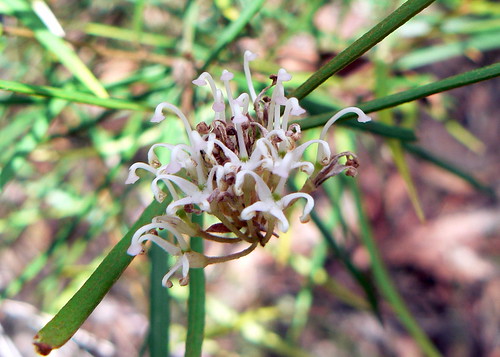
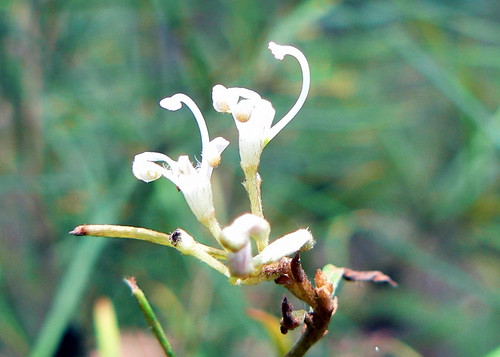
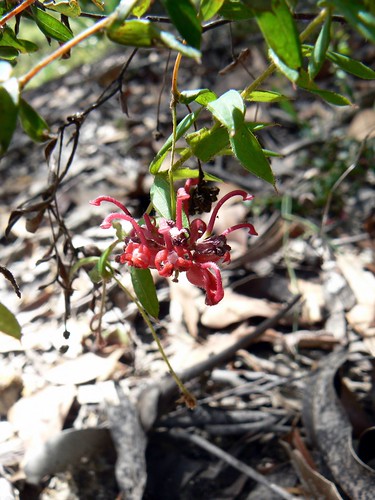
Last year we visited the rainforest and I have never seen more leeches in my life (and that's including my front garden!) so while the interns and a few members of staff walked down to the creek, I lingered near the vehicles and took photos. Bob Makinson, one of my colleagues and the coordinator of the Centre for Plant Conservation at the Herbarium, is one of the world's foremost experts on the Grevillea genus. We have plans to collaborate on an ID CD, so he and I set forth in search of some specimens to photograph, specifically Grevillea linearifolia and Grevillea oldei. Bob has identified a possible subspecies of the former, and plans further investigation to see if a taxonomic change is warranted.

Here is the inflorescence:

Grevillea linearifolia flower 1

And some single flowers:

Grevillea linearifolia (single flower)

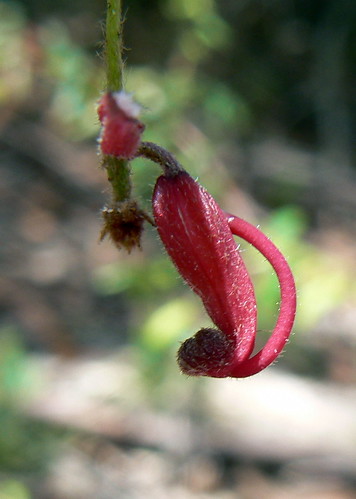
The Grevillea oldei flower is difficult to photograph in situ because of its habit (pun intended!) of hanging low to the ground. I took this image by lying with my chin on the dirt.

Grevillea oldei single flower

This shot required rather less in the way of contortionism:

Grevillea oldei inflorescence

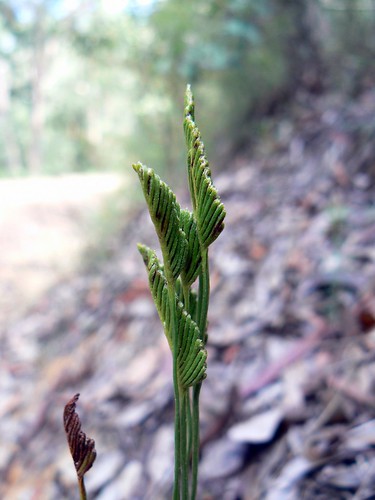
Nothing at all to do with Grevillea is this gorgeous little fern that caught my eye, Schizaea bifida:


Schizaea bifida

What a honey. I'd love one in my garden. I really need to work on my fern propagation skills....

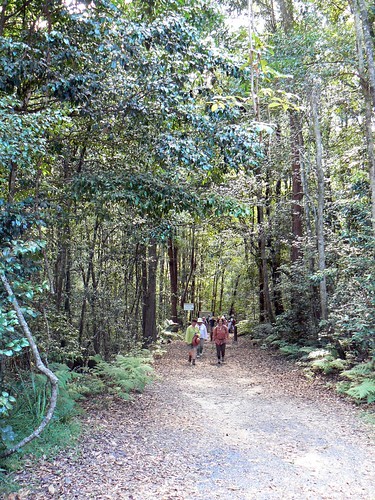
The interns emerge from the rainforest. Because we're lovely people, we'd driven the vehicles down to pick them up....

Strickland State Forest